
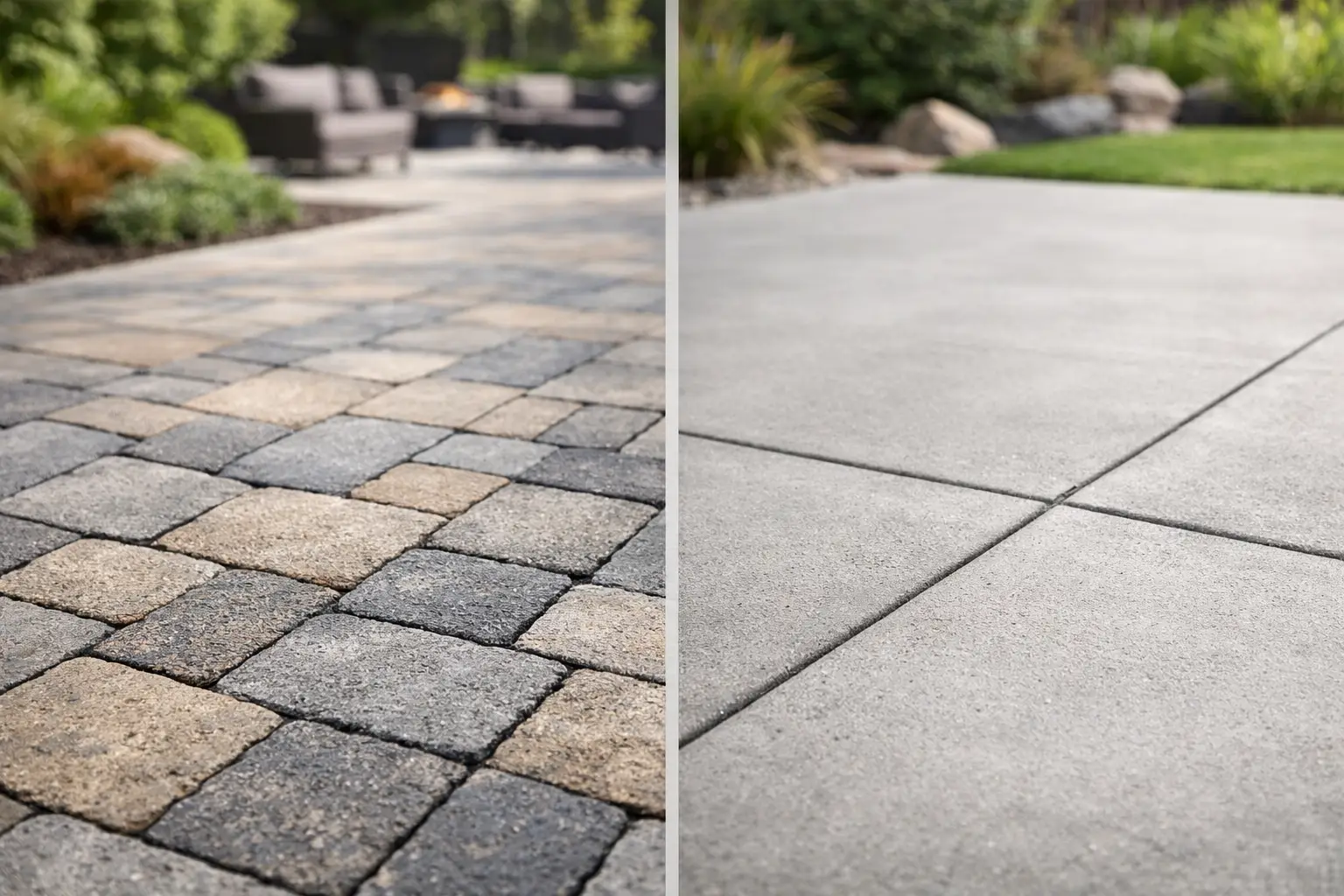
A driveway, pool deck, or terrace can occupy more visual area than the home’s front elevation. That is why the pavers versus poured concrete decision should not be treated as a simple material selection. It affects drainage, maintenance access, comfort underfoot, architectural character, construction sequencing, and how well the exterior performs over time.
For a high-investment residence, the right answer is rarely based on one factor alone. Pavers offer modularity, repairability, and a broad design vocabulary. Poured concrete can provide a clean, monolithic appearance and may suit contemporary compositions or large service areas. The better choice depends on the site, the intended use, the selected finish, and the level of detail built into the plans.
Pavers Versus Poured Concrete: The Design Difference
Pavers create rhythm. Their individual units establish scale, direction, texture, and pattern across a driveway or terrace. A running bond can make a long motor court feel more grounded, while large-format stone pavers can support a restrained, architectural setting. Borders, inlays, banding, and transitions can be designed to align with the home’s geometry and outdoor rooms rather than appearing as an afterthought.
Poured concrete reads differently. It is continuous, quiet, and often more minimal. In the right setting, especially with carefully located control joints and a refined finish, concrete can support a modern architectural language. Its visual strength is broad, uninterrupted surface area.
The distinction matters because hardscape should relate to the architecture, planting, gates, walls, pool coping, and drainage system as one composition. A material that looks appropriate in a small sample may feel too busy, too flat, or too institutional when extended across several thousand square feet. Scale and layout should be evaluated in plan and, when appropriate, through renderings or physical mockups before construction begins.
Site Conditions Often Decide the Material
In Florida, hardscape performance is closely tied to water management. Intense rainfall, high water tables in some locations, and subtle changes in finish elevation can create drainage problems that are not obvious until after installation. Neither pavers nor concrete corrects a poor grading plan.
Paver systems are permeable at their joints, even when installed over a conventional compacted base rather than as a purpose-designed permeable pavement system. That does not mean water simply disappears. The base, edge restraints, adjacent grades, and drainage paths must be designed to move water appropriately and avoid settlement. For driveways, the base design must also account for vehicle loads, turning movements, and areas where wheels repeatedly track.
Poured concrete sheds water across its surface, which can make slopes and drain locations especially consequential. A nearly level slab may look clean on paper but hold water at joints, near walls, or at low points. Proper pitch, drainage inlets, and transitions at thresholds are essential. On luxury properties, the most expensive repairs often result from elevation and drainage decisions made before the decorative finish is chosen.
Durability Is More Than Surface Strength
Concrete is frequently assumed to be the more durable option because it is a single solid slab. It is certainly strong when properly specified and placed. Yet concrete is designed to crack at control joints, and it can crack outside them as soils move, temperatures change, or loading exceeds expectations. Cracking is not always a structural failure, but it can become a visual and maintenance concern, particularly in prominent areas.
Pavers do not eliminate movement. They distribute it differently. Because the surface is made of individual units, minor settlement may be more localized and less visually disruptive. A properly installed paver field can flex slightly with the base while maintaining its overall pattern. The critical detail is the foundation beneath it: excavation depth, compacted base material, bedding layer, joint sand, edge restraint, and transitions all affect longevity.
For both materials, quality control matters as much as material selection. A refined finish installed over inadequate base preparation, poor drainage, or incorrect elevations will not perform like a luxury installation. Construction documents should identify materials, patterns, edge details, slopes, drainage interfaces, and installation expectations so the work can be evaluated against a clear standard.
Repairs Favor Pavers, but They Still Require Expertise
One of the most practical advantages of pavers is repair access. If irrigation work, drainage corrections, utility repairs, or localized settlement occurs beneath a paved area, individual units can often be lifted, the underlying condition corrected, and the surface reinstalled. When matching material has been retained from the original project, the repair can be difficult to detect.
Concrete repairs are more challenging to conceal. A patched section can differ in color, aggregate exposure, texture, or weathering from the surrounding slab. Sawcutting and replacement may be necessary for a clean repair, but the new panel can still remain visible. This is especially relevant around pool equipment, lighting conduits, drainage structures, and future site improvements.
That said, pavers are not maintenance-free. Joint sand can diminish over time, particularly near roof runoff or areas exposed to frequent washing. Edge restraints can fail if they were not installed correctly. Efflorescence, staining, and color variation should be anticipated and discussed before installation. A well-designed system includes practical maintenance expectations, not just an attractive material board.
Cost Should Be Evaluated Over the Whole Project
Initial cost comparisons can be misleading. Standard poured concrete is often less expensive than a premium paver installation, particularly across large, straightforward areas. However, decorative concrete finishes, complex forming, premium sealers, staining, exposed aggregate, and detailed joint layouts can narrow the difference.
Pavers carry costs for materials, labor, excavation, base preparation, cutting, borders, and pattern complexity. They may be the more significant upfront investment, but they can also provide more flexibility for repair, phased work, and future modifications. The value is not only in the material itself. It is in how the surface supports the property’s long-term use and visual standard.
For a custom residence, the question is not simply which option costs less per square foot. It is whether the selected hardscape will complement the architecture, accommodate drainage requirements, withstand expected use, and avoid premature visual compromise. A driveway that becomes the dominant feature of the front approach because its scale or finish is wrong is not a value, regardless of its initial price.
Heat, Comfort, and Poolside Use
Surface temperature deserves attention in Southwest Florida, especially around pools, outdoor kitchens, and uncovered terraces. Darker colors and dense materials generally absorb more heat. Concrete and pavers can both become uncomfortable in full sun, depending on color, texture, and exposure.
Pavers offer more choices in color blends, natural stone appearances, and textured finishes that can improve traction and help moderate glare. Concrete can also be finished for slip resistance, but finish selection must be coordinated with the intended use. A highly textured surface may improve grip yet feel abrasive on bare feet. A smooth finish may look elegant but can be unsuitable around wet areas.
Pool decks require particularly careful detailing. Coping, drainage, expansion joints, deck slopes, furniture zones, and the transition to planting beds must work together. The best-looking surface is not successful if it sends water toward the house, becomes slippery, or makes everyday pool use uncomfortable.
When Concrete Is the Better Choice
Poured concrete can be the right specification for service courts, contemporary courtyards, foundations for certain outdoor structures, or large areas where a restrained monolithic appearance is central to the design. It may also be appropriate when the project calls for precise, broad planes with minimal visual joints.
The key is to design the joints rather than treating them as an unavoidable interruption. Joint placement should reinforce the architecture, align with changes in plane, and avoid awkward fragments at doors, columns, or drainage elements. Concrete can appear exceptionally refined when its layout, finish, and drainage strategy are resolved early.
When Pavers Are the Better Choice
Pavers are often well suited to driveways, arrival courts, terraces, walkways, and pool decks where visual richness, pattern control, and future repair access are priorities. They are especially valuable where the hardscape must transition among multiple outdoor spaces or relate to varied architectural materials.
They also allow a project team to build hierarchy into the site. A primary driveway can use a different scale or border treatment than a guest walk, while a terrace can shift to a more refined field pattern without losing continuity. This level of control is one reason pavers remain a strong choice for detailed residential environments.
The most successful hardscape begins with the site, not a catalog sample. Establish the required grades, drainage routes, structural needs, architectural lines, and intended use first. Then select pavers or poured concrete as part of a coordinated exterior plan that will look purposeful on opening day and perform with confidence for years to come.