
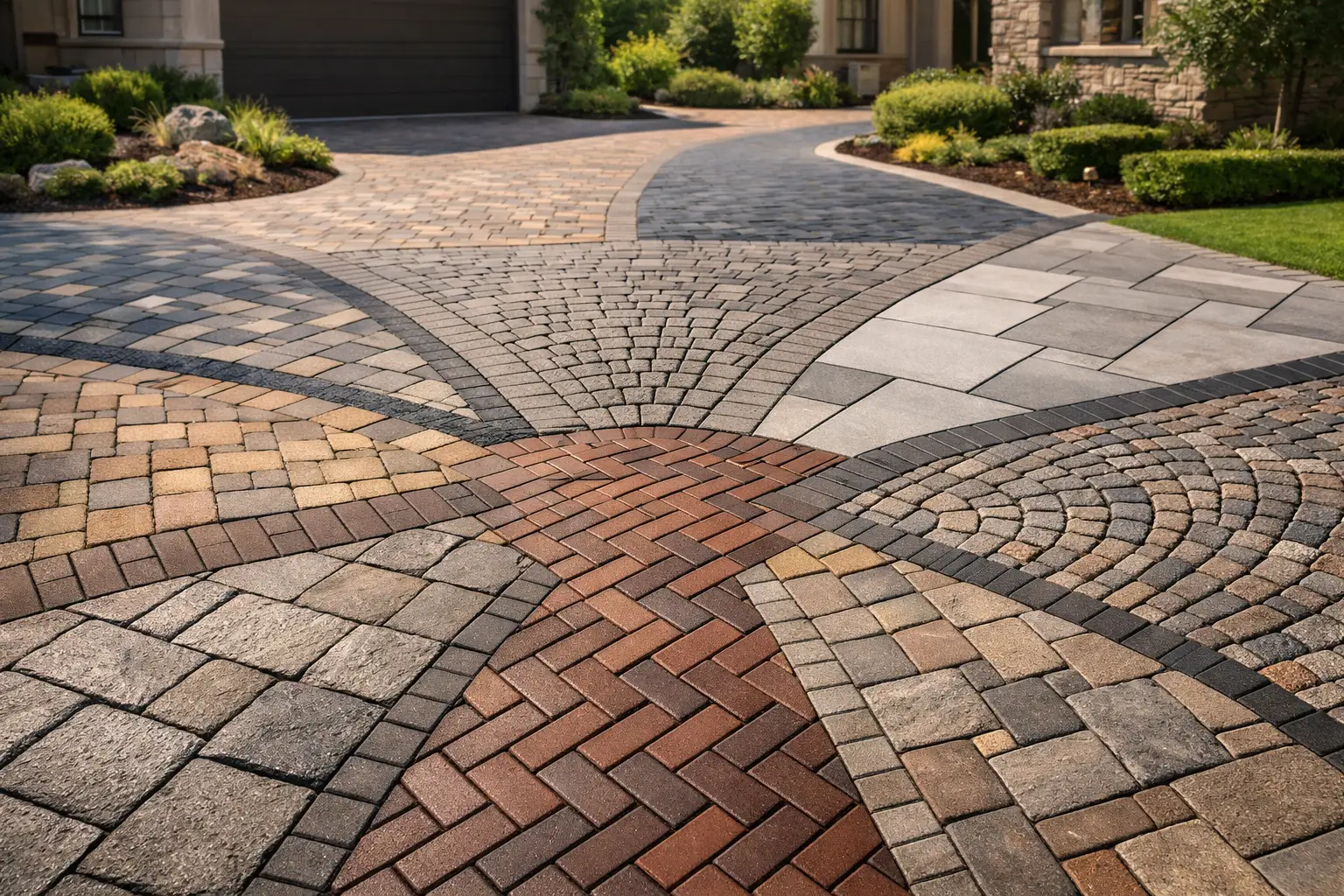
A driveway sets expectations before the front door ever comes into view. On a custom home, the pattern under the tires matters as much as the material itself. The best paver driveway patterns do more than add visual interest – they control scale, support vehicle traffic, complement architecture, and help a finished landscape feel intentional rather than pieced together.
For high-end residential work, pattern selection should never be treated as a late-stage decorative choice. It belongs in the broader hardscape plan, alongside grading, drainage, garage approach geometry, walk connections, and the character of the home. A pattern that looks excellent in a showroom sample can feel too busy on a long motor court, while a simple layout can become striking when the proportions, edge detailing, and color blending are handled correctly.
What makes the best paver driveway patterns work
The right pattern balances appearance with performance. That sounds obvious, but in practice many driveways lean too far one way. Some are visually bold yet create awkward cuts and weak edge conditions. Others are structurally sound but read flat and generic against an otherwise refined property.
Scale is often the first issue. Larger homes generally benefit from patterns that read clearly from the street and from the front entry sequence. Small-format pavers in an intricate layout can be beautiful, but on a broad driveway they may create visual noise. By contrast, oversized units with too little modulation can make a modest frontage feel sparse or unfinished.
Traffic behavior also matters. A driveway is not a patio. Cars turn, brake, pivot, and repeat the same path every day. Patterns need to support that wear pattern, especially near garage doors, guest parking zones, and curb transitions. In Florida, drainage planning is equally important. Surface flow, base preparation, and edge restraint all influence long-term performance, and pattern choice affects how well the installation accommodates those technical demands.
1. Herringbone remains the most reliable choice
If a client asks for one of the best paver driveway patterns with the strongest all-around performance, herringbone is usually the leading answer. The interlocking geometry resists shifting under vehicular traffic better than many purely linear layouts, which is why it is a standard recommendation for driveways rather than just walkways.
A 45-degree herringbone often feels more dynamic and formal. It introduces movement across the field and can soften the straight run of a long driveway. A 90-degree herringbone reads slightly more structured and can align better with architecture that favors clean orthogonal lines.
The trade-off is visual intensity. Herringbone has a lot of pattern activity, so it benefits from disciplined color selection. On a luxury home, muted tonal variation usually performs better than a high-contrast blend. Borders are also important. A soldier course or clean perimeter band can frame the field and keep the pattern from feeling restless.
2. Running bond is understated and architectural
Running bond is one of the simplest patterns, but simplicity should not be mistaken for weakness. When used with the right paver proportions and a carefully designed border, it can look crisp, tailored, and appropriate for contemporary or transitional homes.
This pattern works particularly well when the design intent is calm and linear. It can visually elongate a drive, which may be useful on narrow sites. It also pairs well with modern homes that rely on strong geometry and restrained detailing.
Its limitation is structural compared with herringbone. Running bond does not interlock in the same way, so installation quality becomes even more critical. It is often better suited to lighter-use areas or driveways where the base, edge restraints, and vehicular turning movements have been addressed with precision.
3. Basketweave brings classic character
Basketweave has a traditional quality that suits homes with historic references, coastal estate character, or a more established garden setting. It introduces pattern variation without becoming overly ornate, and it can lend a sense of craftsmanship that feels appropriate on older architectural styles.
The key is moderation. Basketweave can be excellent on a court, guest parking bay, or secondary driveway zone, but on a very large driveway it may start to feel busy. The pattern typically looks best with pavers that have a refined texture and a color palette that stays controlled.
For luxury properties, basketweave often performs best when integrated as part of a broader composition rather than applied everywhere. Used selectively, it can create distinction without overpowering the front elevation.
4. Stacked bond fits modern homes, with caveats
Stacked bond creates a clean grid. That makes it appealing for contemporary architecture where the goal is order, alignment, and minimal visual interruption. With large-format pavers, the result can be striking.
This is one of the more design-sensitive choices among the best paver driveway patterns because the margin for error is small. Any inconsistency in spacing, edge alignment, or transitions becomes obvious. Structurally, stacked bond also lacks the interlock advantage of herringbone, so it requires thoughtful detailing and a properly engineered installation.
Where it works, it works very well. Homes with modern facades, strong horizontal lines, and restrained planting palettes can benefit from the deliberate clarity of stacked bond. It is less convincing on traditional architecture unless balanced by softer material choices elsewhere.
5. Random modular patterns create a custom look
A random modular pattern uses multiple paver sizes in a planned repeating arrangement. Done well, it feels custom and elevated rather than predictable. It is especially useful when the goal is to reduce the repetitiveness of a large paved area.
This pattern can help large driveways feel scaled and composed, especially on estate properties where a single-format field may seem too stark. It also works across a range of architectural styles, from Mediterranean-inspired homes to transitional residences.
The risk is inconsistency. Not every so-called random layout is well proportioned, and poor module selection can look arbitrary. The pattern should be drawn intentionally, not improvised in the field. This is where design documentation matters, because the exact arrangement influences both appearance and installation efficiency.
6. Circular and radial patterns make a focal point
For motor courts, arrival circles, or feature insets, radial patterns can introduce a sense of formality and arrival. They are not usually the right choice for an entire driveway, but they can be highly effective as a focal element within a larger layout.
A circular pattern can organize a court, highlight a fountain or specimen tree, or reinforce the symmetry of the home. In the right setting, it adds distinction that a purely linear field pattern cannot.
It also introduces more cutting, more layout complexity, and more opportunities for installation mistakes. Because of that, it tends to be best reserved for locations where the architectural payoff justifies the added effort. On many properties, a restrained field pattern with a radial accent is the stronger answer.
7. Chevron offers movement with a cleaner read
Chevron is often confused with herringbone, but the effect is different. Because the pavers meet in a continuous V shape, chevron can look more tailored and directional. It works well on long, straight approaches where the design intent is elegant movement toward the home.
Compared with herringbone, chevron may feel slightly more refined and slightly less utilitarian. It can be a strong fit for homes that want pattern without a traditional look. Still, it depends heavily on product availability and installer skill, since true chevron layouts require precise units and careful alignment.
For some projects, the visual benefit is worth that effort. For others, a herringbone pattern delivers comparable energy with fewer complications.
8. Mixed-field patterns with borders often perform best
In many custom projects, the best answer is not a single pattern but a combination. A herringbone or modular field may handle the main vehicular area, while borders, banding, or inset panels define the edges and connect the driveway to walks, courtyards, or entry terraces.
This layered approach often produces the most polished result. It allows the main field to remain structurally sound and visually calm while adding enough detail to feel bespoke. Borders can also help resolve geometry where the driveway meets curved planting beds, gate piers, or garage aprons.
The most successful compositions are disciplined. Too many pattern changes can make a driveway feel fragmented. Usually, one dominant field pattern and one supporting border treatment is enough.
How to choose among the best paver driveway patterns
Architecture should lead the decision. A Mediterranean or coastal estate may support a modular layout or basketweave in ways a sharp contemporary house will not. A modern residence may call for stacked bond or a simplified running bond field with crisp edge detailing.
Driveway size changes the answer too. Broad motor courts can carry more pattern complexity than short suburban approaches. On smaller sites, simpler patterns often look more expensive because they keep the space from feeling crowded.
Then there is the technical side, which should never be separated from aesthetics. Turning radii, slope, drainage, paver thickness, joint stability, and edge restraint all influence which pattern will perform well over time. This is one reason design-led planning matters. A driveway should not be selected from a catalog image alone.
For clients who want the safest high-performance choice, herringbone remains hard to beat. For those prioritizing a more architectural look, running bond, stacked bond, or a refined modular pattern may be stronger. The right answer depends on the home, the site, and how the driveway fits into the full landscape composition.
At Nova LA Designs, that pattern decision is treated as part of the overall design and construction logic, not just a surface finish. That is usually the difference between a driveway that simply looks attractive at completion and one that still feels correct years later. Choose a pattern that belongs to the property, and the driveway will do more than carry vehicles – it will carry the design.