
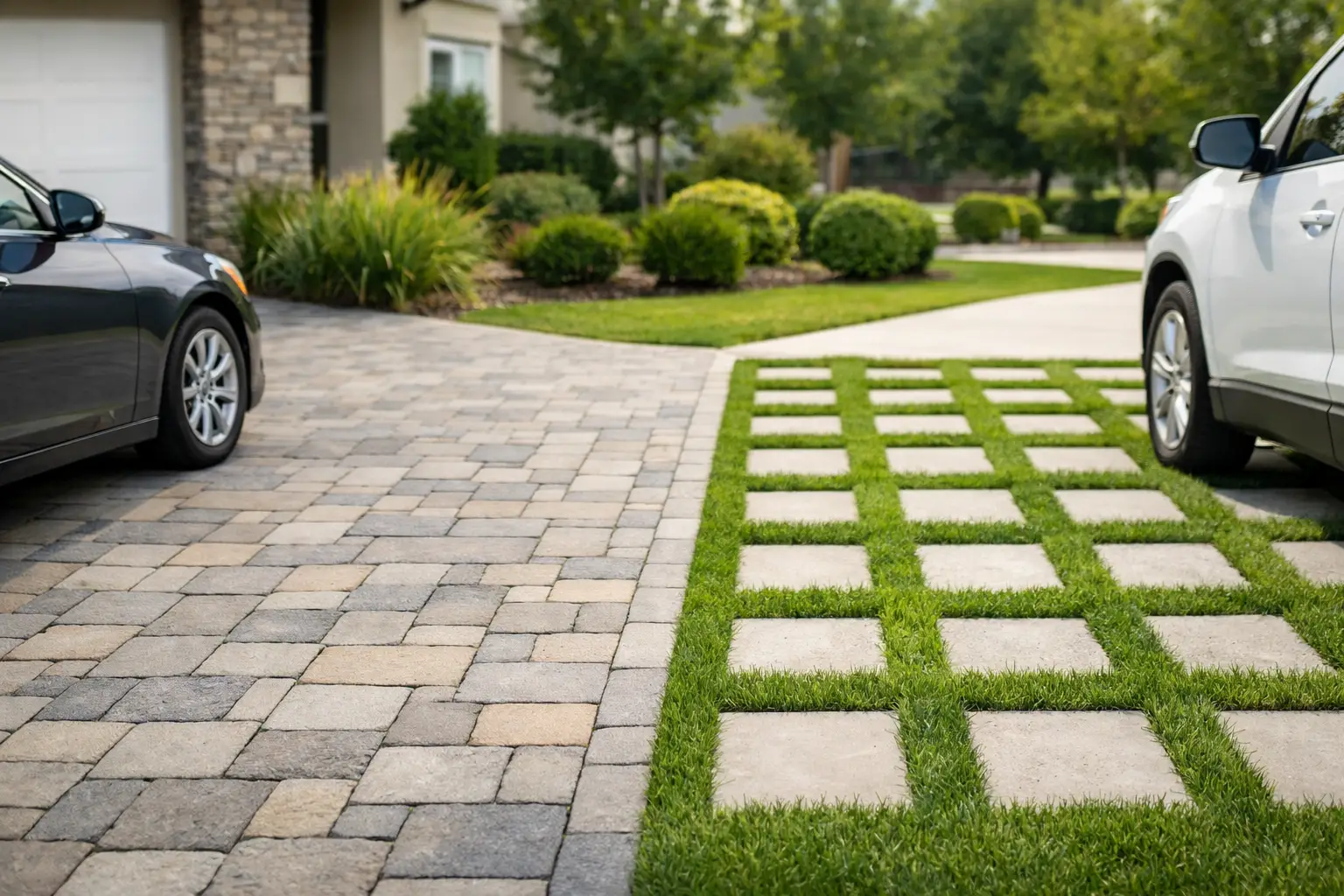
A driveway sets the tone before anyone reaches the front door. In high-end residential design, the choice between pavers versus turf driveway is rarely just about looks. It affects stormwater behavior, maintenance demands, curb appeal, and how well the entry experience aligns with the architecture of the home.
For some properties, pavers provide the right level of structure, permanence, and finish. For others, a turf driveway introduces a softer, more tailored character that feels integrated with the landscape rather than imposed on it. The better option depends on how the property functions, how the home is detailed, and how much performance is expected from the surface over time.
Pavers versus turf driveway: the real decision points
At a glance, pavers often read as the more formal and durable choice, while turf can appear more contemporary, understated, or estate-like depending on the layout. That first impression is valid, but it is only one layer of the decision.
A driveway needs to carry vehicle loads consistently, manage water responsibly, and hold its appearance through weather cycles, turning movements, guest parking, and service access. In Florida, that also means considering rainfall intensity, heat, irrigation coordination, and how materials respond in a humid environment.
When clients compare pavers versus turf driveway options, the most useful framework is not which one is better in general. It is which one is better for this site, this home, and this level of use.
Where pavers typically perform best
Pavers remain a preferred solution for many luxury homes because they offer clarity and control. They create a finished architectural surface, can be detailed to complement the residence, and generally perform well under daily vehicle traffic when installed over the right base.
From a design standpoint, pavers give substantial flexibility. Pattern, scale, color, edge treatment, and banding can be selected to echo the home’s materials and proportions. A Mediterranean residence may call for a warmer, textured field, while a more contemporary home may benefit from larger-format units with restrained joint lines and a cleaner palette.
They also tend to be more forgiving in active drive zones. If a driveway sees frequent arrivals, guest overflow, service vehicles, or repeated turning movements, pavers usually provide a more stable and predictable surface than turf systems. That matters on larger estates and custom homes where the driveway is expected to do more than accommodate two cars.
Maintenance is another reason pavers are often favored. While no exterior surface is maintenance-free, pavers do not require mowing, fertilization, irrigation, or routine turf repair. They may need periodic cleaning, weed control at joints, and occasional resetting if settlement occurs, but the upkeep is generally more straightforward and easier to plan for.
The trade-off is that pavers can create a harder visual effect if they are overused or poorly detailed. They also absorb and reflect heat, and in some cases they contribute to a front approach that feels more paved than landscaped. Good design resolves that by balancing hardscape with planting, grading, and material transitions.
Where a turf driveway makes sense
A turf driveway can be a compelling choice when the goal is to reduce the visual dominance of paving and create a softer arrival sequence. The format is often used with wheel strips, reinforced turf systems, or structured grass panels that allow vehicles to pass while preserving a green surface between and around the load-bearing zones.
On the right property, this can look exceptional. It works especially well where architecture and site planning favor a more understated approach, or where the owner wants the motor court or front drive to feel less engineered and more integrated with the landscape.
Turf can also support permeability goals, depending on the system and subgrade design. That benefit should be evaluated carefully, not assumed. A permeable concept only works if the underlying soils, drainage strategy, slope, and adjacent site conditions support infiltration or controlled movement of water. In Florida, heavy storm events can expose weak planning quickly.
The main limitation is wear. A turf driveway is generally less tolerant of constant traffic, aggressive turning, and repeated stationary loads. If vehicles regularly sit in one place, if guests frequently leave the paved path, or if large delivery and service vehicles use the drive, the surface may decline faster than expected. Even reinforced systems need the right use pattern to stay attractive.
Maintenance is also more involved than many homeowners initially expect. Natural turf requires mowing, edging, irrigation calibration, fertilization, and repair of thin or worn areas. If the driveway is intended to look refined year-round, that standard must be maintained consistently. A neglected turf driveway stops looking intentional very quickly.
Drainage and grading usually decide the winner
For many properties, the true answer to pavers versus turf driveway is determined below the surface. Subgrade preparation, base design, grading transitions, and water management have more influence on long-term performance than the finish material alone.
A beautifully selected paver can fail if runoff is trapped, if settlement is not addressed, or if the base is undersized for vehicle load. A turf driveway can struggle if grades are too steep, if water ponds in wheel paths, or if irrigation keeps root zones too wet. These are not cosmetic problems. They are design and construction problems.
That is why driveway design should be coordinated with drainage plans, hardscape layout, and the larger landscape strategy from the start. On custom residential work, especially where grade change, retaining elements, or complex architecture are involved, this coordination protects both appearance and performance.
Cost is not just installation cost
Pavers often carry a higher initial installation cost than simpler turf systems, especially when premium materials and detailed patterns are involved. But that does not automatically make turf the more economical option.
Lifecycle cost matters. If a turf driveway requires regular repair, resodding, specialized reinforcement, irrigation adjustment, and closer maintenance oversight, the long-term expense can narrow the gap. On the other hand, if the driveway is lightly used and the design is appropriate for the site, turf may deliver a distinct visual result without the extent of hardscape investment a full paver field requires.
The question is not simply what costs less on day one. It is which option delivers the desired appearance and service life with an acceptable maintenance burden.
Design character matters as much as performance
Luxury properties are judged by coherence. A driveway should not feel like a standalone material decision. It should reinforce the architecture, the entry sequence, and the overall landscape composition.
Pavers tend to support homes that benefit from definition, rhythm, and a stronger architectural foreground. They can frame an arrival court, connect to walkways and terraces, and create visual order across a large frontage.
Turf driveways are often most successful when restraint is part of the design language. They can reduce the visual footprint of parking and circulation areas, allowing planting, specimen trees, and the home itself to remain dominant. That can be especially effective on estate lots where a softer, less overtly paved expression is desirable.
Neither approach should be selected from a photo alone. What looks elegant on one property may look unresolved on another if the proportions, drainage, or architecture are different.
How to choose between pavers versus turf driveway
A practical decision usually comes down to five factors: traffic volume, turning movement, drainage requirements, maintenance expectations, and architectural fit. If the driveway must handle daily use with minimal visual wear, pavers often provide the stronger answer. If the goal is a softer, greener entry and the use pattern is lighter and well controlled, turf may be appropriate.
For many homes, the best solution is not purely one or the other. A hybrid approach can be more effective, using pavers in high-stress areas such as aprons, guest parking, and turnarounds, while incorporating turf in selected strips or secondary zones to soften the composition. That kind of tailored planning often produces a more refined result than choosing a single material across the entire driveway.
At Nova LA Designs, this is where technical planning and design judgment need to work together. The strongest driveway solutions are not chosen by trend. They are developed through careful review of site conditions, grading, architecture, and the way the property will actually be used.
A well-designed driveway should feel inevitable – as if no other choice would have made as much sense for the home, the land, and the people living there.