
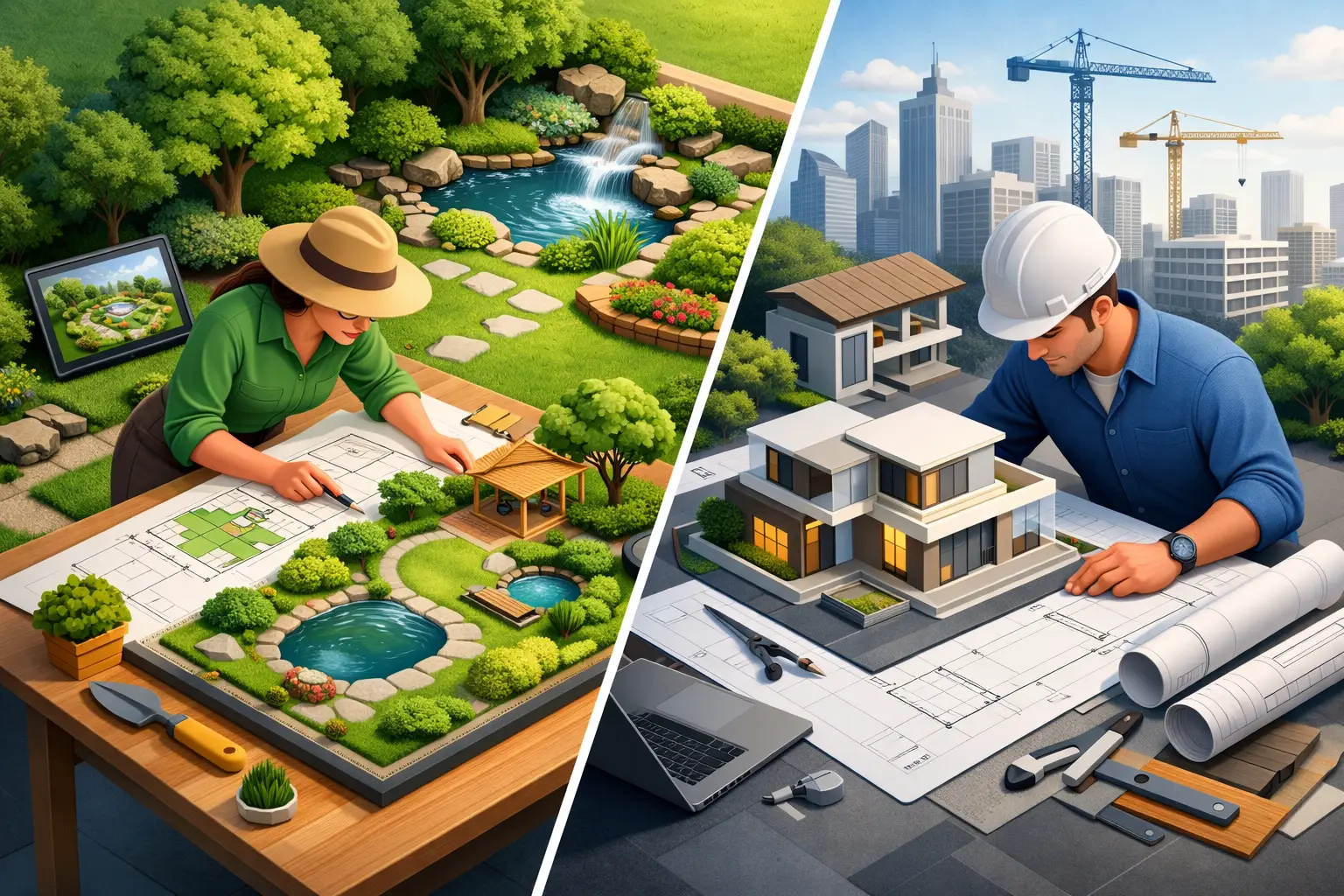
If you are planning a major outdoor project, the difference between landscape designer and landscape architect matters well before the first plant goes in. On a high-value residential property, that choice affects grading, drainage, permitting, construction detailing, and how well the finished landscape performs over time. What looks like a simple design decision at the start can become a costly coordination issue later if the scope requires more technical expertise than expected.
For many homeowners, builders, and design professionals, the confusion is understandable. Both roles can contribute to beautiful outdoor spaces. Both may create planting concepts, layout plans, and material palettes. But they are not interchangeable, especially when a project includes structural hardscape, drainage challenges, code considerations, or complex site planning.
What is the difference between landscape designer and landscape architect?
The clearest difference is that a landscape architect is licensed, while a landscape designer is typically not. That licensing is not just a title distinction. It reflects formal education, examination, and legal responsibility tied to public health, safety, and welfare.
A landscape designer may focus primarily on the visual and horticultural side of a property. That can include planting design, garden layouts, outdoor styling, and smaller-scale improvements. Many designers have strong taste, deep plant knowledge, and years of practical experience. For the right project, that can be more than enough.
A landscape architect works at a broader and more technical level. Depending on the state and project type, that work may include site planning, grading and drainage design, hardscape integration, circulation, irrigation planning, construction documentation, and coordination with architects, engineers, builders, and permitting authorities. The role is not limited to aesthetics. It is design tied directly to buildability and site performance.
That distinction becomes more important as project investment increases.
Where landscape designers add value
Landscape designers are often well suited for projects where the primary goal is visual enhancement rather than site reconfiguration. If a homeowner wants to refresh foundation planting, improve curb appeal, create seasonal color, or develop a garden composition without major construction, a skilled designer can be an excellent fit.
Some designers also handle patios, paths, lighting concepts, and outdoor living ideas. The quality of that work depends heavily on the individual. There are talented landscape designers with strong practical instincts and a refined design eye.
The limitation is scope. Once a project moves beyond decorative improvements and into technical site changes, the lack of licensure and engineering-minded planning can become a real constraint. A design may look polished on paper but leave unresolved questions about elevations, runoff, material transitions, irrigation coverage, or construction detailing.
In other words, a landscape designer may be ideal for a garden refresh. That same approach may be less appropriate for a full-property redesign on a custom home site.
Where landscape architects are typically needed
A landscape architect is generally the better choice when the project has technical complexity, regulatory requirements, or a high expectation for construction coordination. This is especially true on luxury residential properties, waterfront sites, new custom homes, and large renovations where the landscape is being treated as part of the architecture rather than decoration around it.
A landscape architect can evaluate how outdoor spaces should function as a system. That includes how people move through the site, how paving relates to the house, how drainage is resolved, how plantings support the architectural character, and how details are documented so contractors can price and build accurately.
If the project includes retaining conditions, grading adjustments, drainage issues, integrated steps, walls, driveway layouts, pool surroundings, irrigation planning, or formal construction documents, the value of a landscape architect rises quickly. Those are not side issues. They shape whether the landscape holds up physically and visually.
In Florida, this technical layer is often decisive. Flat sites can still have serious drainage challenges. Luxury homes frequently require careful coordination between finished floor elevations, outdoor living areas, stormwater management, and planting performance. The landscape cannot be treated as an afterthought.
Education, licensing, and legal scope
Another key part of the difference between landscape designer and landscape architect is legal scope. A licensed landscape architect has met state requirements to practice landscape architecture. That legal standing may allow them to prepare plans and documents that unlicensed designers cannot, depending on the jurisdiction and project type.
This matters when permitting enters the picture. It also matters when other consultants are involved. Builders, civil engineers, and architects need reliable documentation that addresses dimensions, elevations, materials, and technical intent clearly. A licensed professional is accountable for that work in a way that goes beyond stylistic recommendations.
By contrast, landscape designers do not typically operate under the same regulatory framework. That does not automatically make their work inferior. It simply means the scope is different, and the liability structure is different too.
For a client investing heavily in a property, that distinction should not be overlooked. Credentials are not only about prestige. They affect process, coordination, and risk.
Design vision is not the only question
Many clients assume the decision comes down to creativity. They wonder who has better ideas, stronger taste, or a more refined eye. That is part of the equation, but not the whole one.
The stronger question is whether the designer can carry a concept from vision to execution without losing control of the details. A beautifully imagined plan still needs to be resolved through grading logic, material transitions, drainage strategy, irrigation coverage, and realistic construction sequencing.
That is where landscape architecture tends to separate itself. The discipline is built around the relationship between design intent and physical implementation. On more sophisticated projects, that gap between concept and construction is often where budgets drift and results fall short.
A homeowner may not see that risk in the early design phase. The issues usually appear later, when a contractor needs clarification, an elevation conflicts with drainage, or a paving layout does not align cleanly with the architecture. At that point, the cost of incomplete planning becomes very real.
How to choose the right professional for your project
The right hire depends on what you are actually building.
If the work is largely ornamental, a landscape designer may be sufficient. If the project is centered on plantings, decorative beds, simple garden updates, or a small outdoor refresh, a designer with strong horticultural knowledge may serve the project well.
If the project involves a custom residence, major renovation, hardscape design, grading, drainage correction, irrigation planning, or detailed construction documents, a landscape architect is usually the more appropriate lead. The same is true when multiple consultants are involved and the outdoor environment needs to be integrated with the architecture from the start.
It is also worth looking beyond titles alone. Ask what deliverables will be provided. Will the plan include grading and drainage? Construction details? Irrigation layout? Coordination with the builder and architect? Site observation during installation? Those answers tell you more than marketing language ever will.
For discerning clients, process matters as much as portfolio. A strong professional should be able to explain not only how the space will look, but how it will be documented, built, and verified in the field.
Why the distinction matters more on luxury properties
On a multimillion-dollar home, the landscape is not a finishing touch. It is part of the property’s architecture, value, and daily function. The stakes are higher because mistakes are more expensive and expectations are less forgiving.
A driveway alignment that feels slightly off, a drainage plan that underperforms in heavy rain, or a hardscape layout that ignores architectural proportions can diminish the entire project. These are not cosmetic issues. They affect usability, maintenance, and long-term satisfaction.
That is why many high-end projects benefit from a landscape architect who combines design judgment with technical discipline. Firms such as Nova LA Designs operate in that space, where concept design, planting, hardscape planning, grading, irrigation, and construction oversight must work together rather than as separate conversations.
The best outdoor environments do not happen because someone selected attractive plants. They happen because the full site was understood, resolved, and documented with care.
Difference between landscape designer and landscape architect in practical terms
If you want the simplest practical answer, here it is: a landscape designer may help you decide what to place on the property, while a landscape architect is equipped to determine how the property should work as a whole.
Sometimes those scopes overlap. Sometimes they do not. The larger and more technical the project becomes, the less room there is for ambiguity.
Before hiring anyone, define the real scope of the work, not just the look you want to achieve. A well-designed landscape should be beautiful, but it should also drain correctly, align with the architecture, perform in the climate, and translate cleanly from plan to finished construction. When that is the standard, the right professional becomes much easier to identify.
The smartest first step is not asking who can make it look better. It is asking who can make the entire site work better, with a result that still looks exceptional years later.