
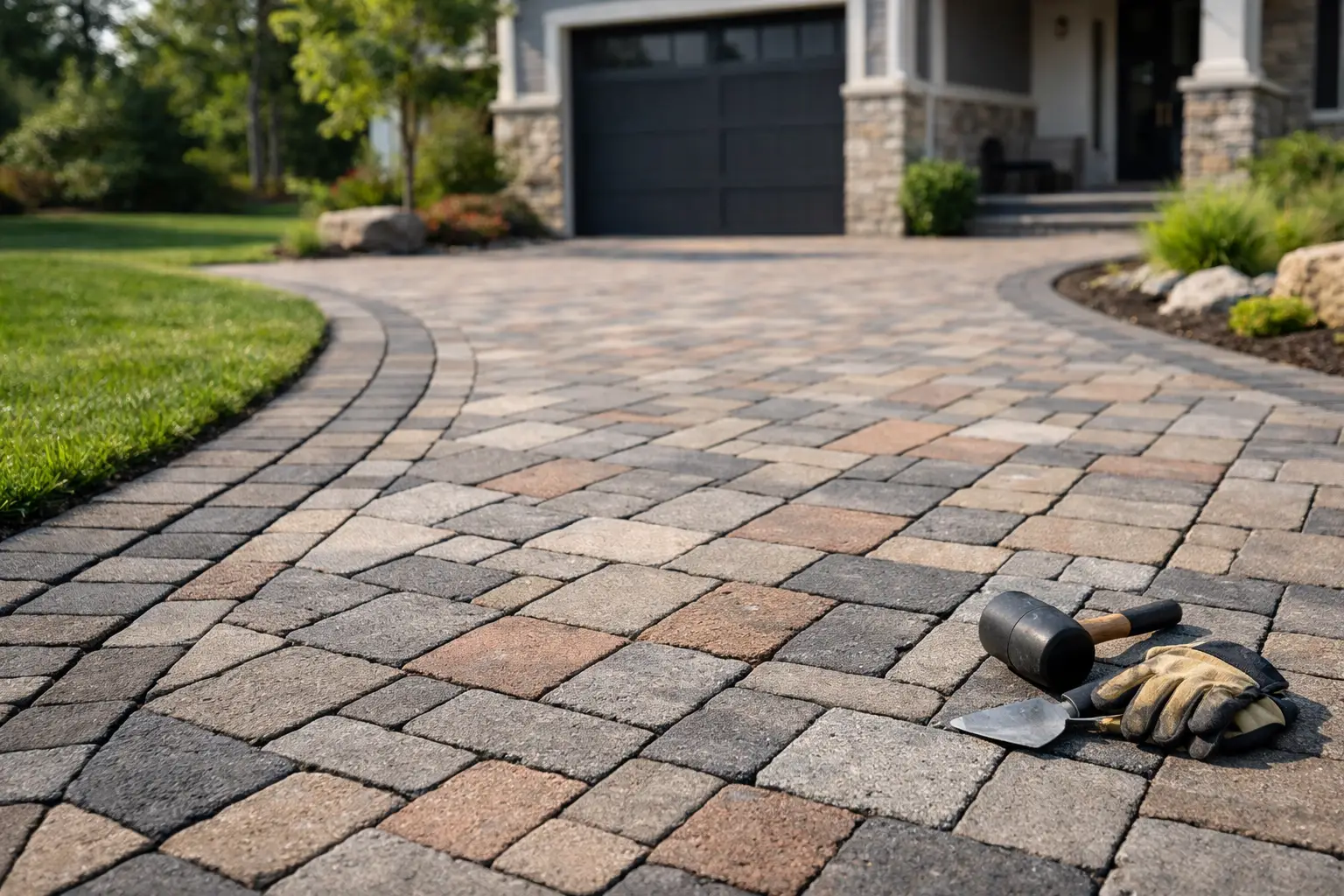
A paver driveway can elevate a home the moment you turn in from the street, but the visual impact is only half the job. When clients ask how to design paver driveways, the real answer starts below the surface – with proportion, grading, drainage, vehicle loads, and how the driveway connects to the architecture and the site as a whole.
On high-value residential properties, driveway design should never be treated as a simple paving selection. It is part of the arrival sequence, part of the stormwater strategy, and often one of the largest hardscape elements on the property. If the geometry is awkward, the drainage is unresolved, or the material is overused, even expensive pavers can look ordinary. If the planning is disciplined, the driveway reads as intentional and performs accordingly.
How to design paver driveways with the site first
The most common mistake is choosing the paver before understanding the site. A well-designed driveway begins with dimensions, turning movements, elevation changes, garage location, drainage patterns, and the relationship to walks, planting, and front entry features.
Start with function. A driveway must comfortably accommodate the vehicles that will use it every day, including guest parking, backing movements, and service access when relevant. A narrow drive may look efficient on paper but feel frustrating in use. A layout that is oversized, on the other hand, can dominate the front yard and dilute the architecture.
This is where proportion matters. The driveway should feel balanced with the scale of the home and the lot width. On larger residences, a straight run may benefit from visual relief through banding, courts, or changes in texture. On tighter properties, restraint often produces the strongest result. More pattern is not always better.
In Florida, site planning also needs to account for rain events and how water moves across the property. Driveway design is closely tied to grading, finished floor elevations, and adjacent landscape areas. If water is allowed to collect along the garage, front walk, or edge restraints, failure tends to show up early.
Layout decisions that affect both appearance and use
Driveway layout is one of the first design choices visitors notice, even if they cannot describe why it feels right or wrong. Straight driveways tend to read clean and formal. Curved alignments can soften the approach and work well on larger lots, but only when the curve is purposeful. An arbitrary bend usually wastes space and complicates installation.
For many custom homes, the driveway should reinforce the architecture rather than compete with it. A contemporary residence may call for a more restrained field pattern with crisp borders and fewer color shifts. A Mediterranean or transitional home may support more variation, but the detailing still needs control. Borders, soldier courses, and accent bands should frame the composition, not overdecorate it.
The arrival sequence also deserves attention. Where does the visitor step out? Is there a clear transition from driveway to walk? Does the driveway edge terminate cleanly at planting beds, walls, or lawn panels? These moments separate a finished design from a surface that was simply installed.
Width, turning radius, and parking expectations
Good driveway design respects how people actually use their property. If homeowners regularly park multiple vehicles, space for maneuvering must be resolved in the layout, not left to improvisation after construction. Motor court areas, guest parking pockets, and widened aprons can help, but they should be integrated into the plan from the beginning.
Turning radius is equally important. Luxury vehicles, larger SUVs, and service trucks need room to move without clipping planted edges or forcing tires onto turf. In compact designs, even small dimensional changes can significantly improve usability.
Material selection is about more than color
Paver choice should support the architecture, the scale of the home, and the performance demands of a vehicular surface. Thickness, compressive strength, finish, edge profile, and compatibility with the intended base system all matter. For driveways, this is not the place to prioritize appearance over specification.
Color is often where homeowners focus first, but tone should be handled carefully. A paver that looks appealing on a sample board can become visually heavy across a large driveway field. In many cases, quieter blends age better and keep the focus on the property rather than the pavement. Highly contrasting borders can be effective, though they need discipline. If every edge, band, and inset is emphasized, the driveway can start to feel fragmented.
Texture also affects the result. A heavily tumbled paver may suit some architectural styles, while a cleaner, more precise surface may be better for contemporary work. The right finish should feel consistent with the residence and adjacent hardscape, including walkways, pool decks, and entry terraces.
Pattern choice and visual scale
Pattern is not just decoration. It influences strength, rhythm, and perceived scale. Some laying patterns distribute vehicular loads more effectively, which is a practical consideration on driveways. Others may look attractive but read too busy across a broad surface.
Larger-format pavers can create a refined appearance, but they require careful detailing and proper structural support. Smaller units can adapt more easily to curves and transitions. The choice depends on the design language of the property and the technical demands of the site.
Base preparation and drainage determine longevity
Anyone serious about how to design paver driveways needs to treat the base and drainage system as core design decisions, not contractor afterthoughts. Surface materials are visible, but subsurface preparation determines whether the driveway remains level, drains correctly, and resists movement over time.
Subgrade evaluation comes first. Soil conditions, compaction requirements, and any unstable areas need to be addressed before base installation begins. The base section must be designed for vehicular loads and local conditions. This is especially important where heavy rain, high water tables, or poor drainage can compromise performance.
Driveway slopes should move water intentionally. The objective is not simply to get water off the pavers, but to direct it where the site can manage it properly. That may include sheet flow to collection points, integration with drainage structures, or coordination with adjacent grading and landscape areas. Water should never be left to find its own route near the garage or front entry.
Edge restraints are another detail that deserves more respect than they often get. Without proper edge support, pavers can spread, shift, and lose alignment. The result may begin at the perimeter, but it rarely stays there.
Designing the driveway as part of the full landscape
The strongest paver driveways are not designed in isolation. They belong to a larger composition that includes architecture, site lines, planting, lighting, and hardscape transitions.
A driveway that occupies a large portion of the front yard benefits from adjacent landscape structure. That does not mean adding planting to soften every edge. It means using trees, low hedges, walls, or ground plane changes to define space and keep the driveway visually integrated with the property. The goal is order.
Lighting should also be considered early. Driveway lighting can improve safety and reinforce the approach, but fixture placement must be coordinated with paving geometry and vehicular use. Poorly positioned lights are often damaged or visually distracting.
Where homes include front courts, guest entries, or detached garages, the paving design should establish hierarchy. Not every paved area needs the same treatment. Sometimes a simpler field paver with a more defined border at the main arrival area creates a better composition than carrying one pattern everywhere.
What to avoid when designing a paver driveway
Most problems come from either overdesign or underplanning. Overdesign shows up in excessive color changes, too many borders, mismatched patterns, or decorative features that compete with the house. Underplanning shows up in puddling, awkward parking, weak edge conditions, and layouts that feel unresolved.
It also helps to be realistic about maintenance. Paver driveways can be durable and repairable, but they are not maintenance-free. Joint performance, settlement at utility cuts or trench areas, staining, and weed intrusion at neglected joints can all affect appearance over time. A sound design anticipates maintenance access and uses details that support long-term serviceability.
For custom residential work, construction documentation matters. Dimensions, grades, drainage intent, pattern layout, edge conditions, and transitions should be drawn clearly enough that the built result reflects the original design. That level of precision is part of why firms such as Nova LA Designs approach paver driveway planning as both a design exercise and a construction discipline.
A paver driveway should do more than look expensive. It should fit the house, handle the site correctly, and still feel composed years after installation. When those priorities are set early, the finished result tends to be quieter, stronger, and far more convincing.