
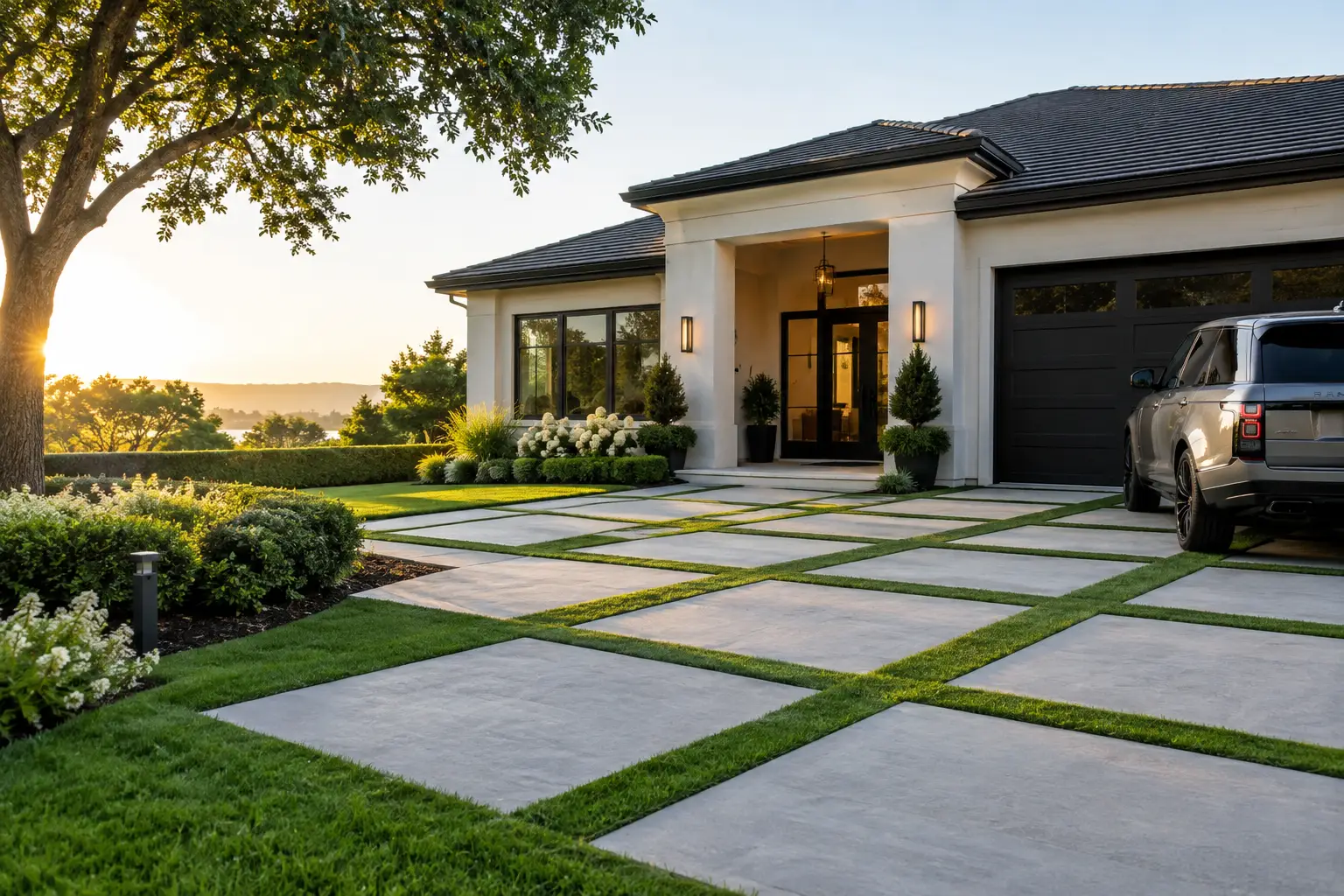
A turf driveway succeeds when it reads as part of the architecture, not as a paved drive with grass inserted afterward. Knowing how to design turf driveways begins with that distinction. The green joints or planted bands may create the visual impression, but the performance depends on proportion, vehicle loading, base preparation, drainage, irrigation, and careful construction oversight.
For high-end residential properties, turf driveways are often used to soften a broad arrival court, extend the geometry of the home into the landscape, or reduce the visual weight of hardscape near the street. They can be exceptionally refined. They can also fail quickly when the planted areas are too narrow, the paving modules are poorly scaled, or water is left to collect beneath the surface.
Start With the Driveway’s Role on the Property
Before selecting pavers or turf, establish what the driveway must do. Is it a single approach to a garage, a motor court serving multiple vehicles, a guest parking area, or an overflow surface used only on occasion? Each condition calls for a different balance of hardscape and planted area.
A primary vehicular route needs a continuous, engineered surface beneath every wheel path. Turf can be integrated between pavers, within wide joints, or as planted ribbons, but it should not be asked to carry repeated turning movements without adequate structural support. A formal arrival court may allow more green area than a heavily used service drive, while a narrow side drive may require a more conservative paving layout to protect the turf.
The architectural language should guide the pattern. Linear pavers with crisp turf joints suit contemporary homes. Larger rectangular modules can reinforce transitional or modern Mediterranean architecture. More traditional residences may benefit from a restrained grid or a drive with solid border courses that visually contain the planted field. The driveway should relate to the home’s material palette, not compete with it.
Design Turf Driveways Around Vehicle Movement
The most attractive layout is not always the most durable one. Tire paths, turning radii, delivery access, and garage alignment should be documented early in the design process. This is particularly important at curves, gate entries, and turnaround areas, where tires scrub across the surface and can damage grass or shift pavers.
A practical approach is to concentrate solid paving where vehicles turn, stop, or change direction, then introduce turf joints or planted panels in lower-stress zones. For example, the entry throat and turning apron of a motor court may be predominantly hardscape, while the central parking field uses a paver-and-turf grid. This preserves the intended visual effect without forcing the planted material to withstand the harshest traffic conditions.
Paver size matters as well. Oversized units can create a clean, generous appearance, but they need precise setting and a base designed for their dimensions. Smaller modules offer more flexibility around curves and irregular site conditions. In either case, joints must be wide enough to establish healthy turf yet narrow enough to retain a disciplined, intentional pattern. Thin grass lines often look elegant in photographs but may not receive enough soil volume, sunlight, or water to remain consistent over time.
Build the Base Before Specifying the Finish
The surface materials are only the visible portion of a turf driveway. Its long-term performance rests on excavation depth, compacted subgrade, base material, edge restraint, and the method used to support the turf areas.
A driveway serving passenger vehicles requires a properly engineered foundation. Soil conditions, anticipated loads, groundwater, and local drainage patterns all affect the required section. In Florida, sandy soils may drain readily in some areas, yet high water tables and intense rainfall can still create instability if grades and base layers are not coordinated. A level-looking driveway is not necessarily a well-drained driveway.
The construction documents should identify elevations, slope direction, drainage collection points, paving limits, and transitions to walks, lawns, gates, and garage slabs. A reliable detail also clarifies how the pavers are restrained at the perimeter and how the planted joints or cells are filled. Without those decisions on paper, field crews may improvise at the stage where precision matters most.
For permeable turf-paver systems, the stone reservoir and separation layers need to work with the site’s drainage strategy. Permeability is valuable, but it is not a substitute for planning where stormwater will go once the underlying soils reach capacity. On properties with constrained drainage or finished floor elevations nearby, surface runoff and subsurface movement should be evaluated together.
Choose Between Turf Joints, Turf Bands, and Grid Systems
There is no single turf driveway detail that suits every residence. The right solution depends on the visual objective, maintenance expectations, and traffic pattern.
Turf joints between individual pavers create a tailored, architectural surface. They are best used where joints can be kept consistent and the driveway receives moderate use. Turf bands, often placed between broad runs of concrete or stone pavers, offer a stronger graphic effect and more soil volume for establishment. They also make it easier to align the drive with the home’s orthogonal geometry.
Open-cell grid systems can support a more heavily planted appearance, especially in guest parking or secondary access areas. However, the grids must be selected and installed for the intended load, and the grass needs enough root-zone depth to survive heat, compaction, and occasional vehicle traffic. They are generally less appropriate for areas where cars repeatedly turn their wheels while stationary.
Natural stone, concrete pavers, porcelain pavers, and cast-in-place concrete can all be integrated with turf. Material selection should consider color stability, slip resistance, heat retention, maintenance, and visual continuity with patios and walkways. A pale material may reduce surface heat but show tire marks more readily. Darker materials can feel more substantial, but they may increase heat stress on adjacent turf during summer.
Select Turf for the Actual Growing Conditions
A turf driveway is not a lawn with a different edging detail. Grass planted within paving receives reflected heat, restricted rooting space, and irregular wear. The species and maintenance plan should reflect those conditions.
In Southwest Florida, turf selection should account for sun exposure, seasonal rainfall, shade from mature canopy trees, and salt exposure where applicable. Full-sun conditions may support a more resilient warm-season turf, while shaded driveways require careful assessment before committing to narrow planted joints. No turf will perform well where dense shade, constant moisture, and daily tire traffic occur together.
Soil within the turf areas should be specified rather than treated as leftover fill. It needs to provide drainage, moisture retention, and sufficient organic content for rooting. The finished grade should sit slightly below the adjacent paving surface so soil and turf are not displaced onto the pavers during rain or irrigation.
Irrigation deserves equal attention. Paver surfaces shed water differently than open lawn, and turf joints can dry out quickly at their edges. Irrigation zones should be designed to cover the planted areas without routinely spraying hardscape, walls, windows, or vehicles. Smart scheduling can reduce waste, but it does not correct poor head placement or inadequate pressure.
Resolve Drainage, Grades, and Transitions Early
Driveways direct a surprising amount of water. When a turf driveway is installed near a residence, courtyard wall, or garage, even minor grading errors can become costly. Water should move away from structures while preserving a composed, nearly invisible slope across the finished surface.
The transition from driveway to garage is especially critical. The driveway should not trap runoff against the slab or send water under a door during a heavy storm. Depending on the condition, a trench drain, subtle swale, slot drain, or carefully pitched apron may be appropriate. The solution should be integrated into the hardscape design rather than added as an afterthought.
Edges also need discipline. Turf driveways often meet planting beds, sidewalks, curbs, or decorative gravel. Clear edge restraint prevents lateral movement of pavers and creates a clean maintenance line. Where the drive meets a lawn, consider whether mower access and irrigation coverage will remain practical after construction.
Plan for Maintenance Without Diluting the Design
A turf driveway asks for more attention than a conventional paved surface. The trade-off is worthwhile when the design delivers a meaningful improvement in appearance, stormwater management, or site character, but the owner should understand the care involved.
Regular mowing, edging, fertilization, weed management, irrigation adjustment, and occasional turf replacement are part of the ownership experience. Paver joints may need periodic cleaning, and settled areas should be addressed before they become uneven. For seasonal residences, the landscape maintenance team should receive clear direction on the intended turf height, joint care, and restrictions on herbicide use near the planted surface.
The design can reduce maintenance pressure. Avoid overly narrow turf strips, eliminate awkward triangular planting pockets, provide solid paving at high-wear locations, and keep the pattern simple enough to repair without disrupting the whole field. Precision is not just aesthetic. It is what makes future maintenance manageable.
Use Documentation and Field Review to Protect the Investment
Turf driveways are detail-driven installations. A design package should coordinate layout dimensions, materials, grading, drainage, irrigation, planting, and construction details so that each trade understands its scope. CAD plans and 3D studies can be valuable for reviewing paver rhythm, driveway scale, and the relationship between the arrival sequence and the home before work begins.
Field observation remains equally valuable. Subgrade preparation, base compaction, edge restraint, drain elevations, and finished turf grades are difficult to judge after the surface is complete. Hands-on review at the appropriate construction stages helps preserve the design intent and catch issues while they are still practical to correct.
A well-designed turf driveway should feel composed from the street, comfortable underfoot, and dependable under a vehicle. When every layer is considered with the same care as the finished pattern, the driveway becomes a purposeful part of the landscape rather than simply a place to park.