
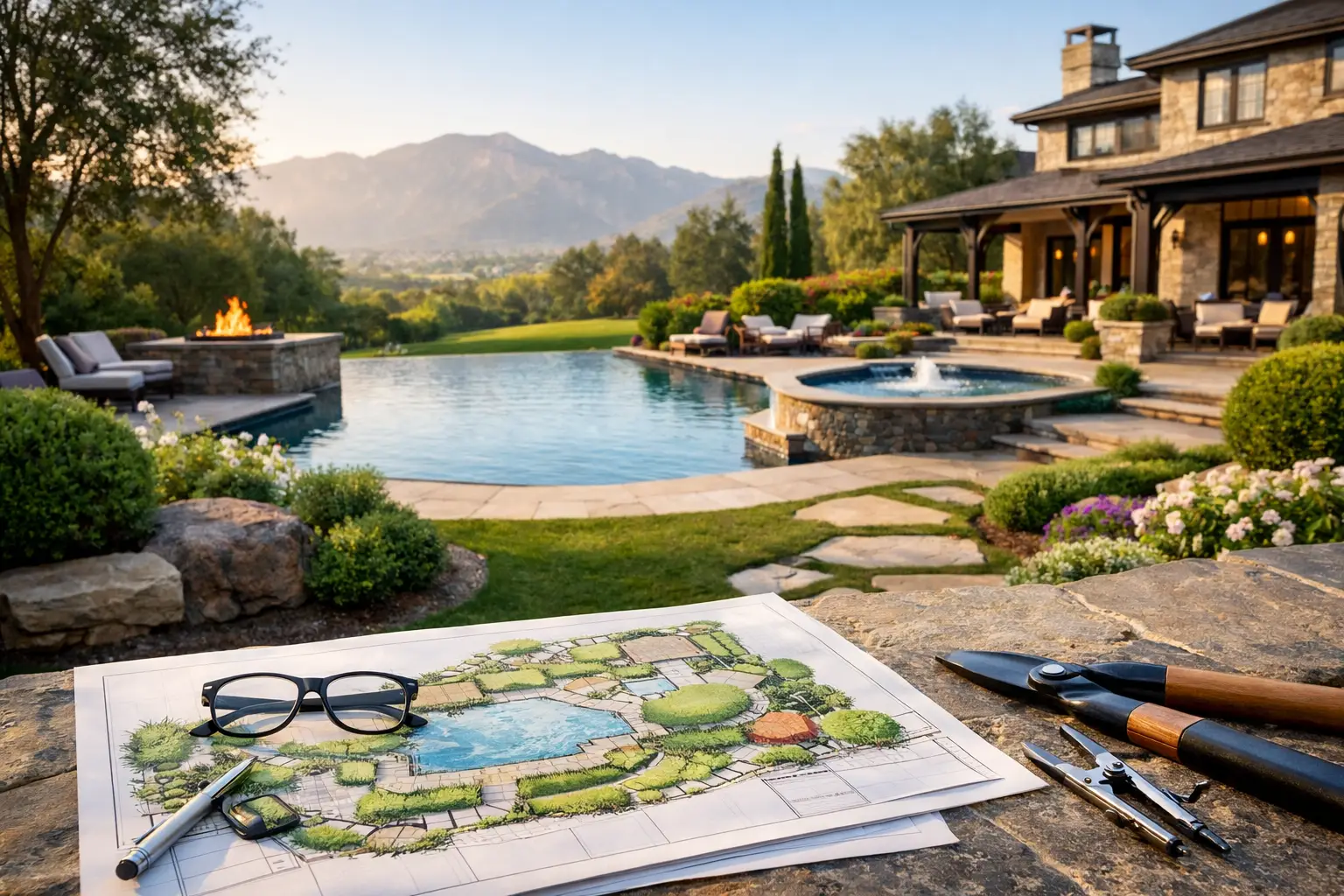
A high-end home rarely falls short because of architecture alone. More often, the missed opportunity is outside – where grade changes feel unresolved, the arrival sequence lacks presence, drainage is treated as an afterthought, or the outdoor rooms never function as well as they look in a rendering. A strong luxury landscape planning guide starts there, with the reality that exceptional landscapes are not assembled from finishes and plant palettes. They are planned as part of the property itself.
For custom residences and estate-scale projects, landscape planning is not decorative work layered on at the end. It is a design and technical discipline that shapes how the property is entered, viewed, used, drained, lit, and built. The earlier this process begins, the better the outcome. That is especially true when the landscape must align with architecture, pool design, driveway geometry, privacy requirements, and complex site conditions.
What a luxury landscape planning guide should actually cover
The phrase is often used loosely, but a true luxury landscape planning guide should address more than style preferences. It should define how the property will perform over time. That includes circulation, grading, drainage, hardscape relationships, planting structure, irrigation strategy, and the level of documentation required for accurate construction.
On a high-value property, each of those systems affects the others. A widened motor court changes grading. Grading affects drainage flow. Drainage infrastructure influences root zones and planting areas. Pool deck elevations affect transitions to terraces, lawns, and guest access paths. If these decisions are made in isolation, the result is usually expensive revision during construction.
Good planning avoids that by establishing order early. It gives the homeowner and project team a framework for design decisions before materials are selected or installations begin.
Begin with the site, not the plant list
Luxury clients are often shown inspiration images before anyone has fully analyzed the property. That can be useful for taste alignment, but it should not drive the first planning moves. The first serious step is understanding the site as it exists.
That means studying topography, drainage patterns, utilities, setbacks, existing trees, easements, views, sun exposure, and adjacent conditions. It also means understanding how the architecture sits on the lot and where the landscape needs to provide transition, scale, privacy, or visual restraint. A waterfront property, an infill estate lot, and a large suburban parcel may all support refined outdoor design, but they require different planning logic.
In Florida, drainage and water management deserve special attention. A beautiful plan that does not account for stormwater behavior, finish floor relationships, and water movement across hardscape will create persistent problems. Standing water, settlement, edge failures, and turf decline are usually planning failures before they become maintenance issues.
Plan the experience of the property
Luxury landscape design is often judged by appearance, but the more meaningful standard is experience. How the property unfolds from the street to the front entry matters. So does the transition from interior living spaces to terraces, pools, gardens, and secondary destinations.
A well-planned site establishes a sequence. Arrival should feel intentional, not oversized or visually crowded. Front walk and driveway relationships should support the architecture rather than compete with it. Outdoor entertaining areas should have enough space for actual use, not just enough space to photograph well. Private zones should feel protected without becoming heavy or overplanted.
This is where many projects benefit from a design-forward but technically grounded approach. The landscape architect is not simply arranging elements. The role is to organize the site so circulation, views, privacy, and utility all work together.
Hardscape sets the discipline of the project
Planting brings softness and depth, but hardscape usually determines whether a luxury landscape feels resolved. Walls, paving, steps, terraces, driveways, drainage structures, and edge conditions create the framework that everything else depends on.
This is also where budget discipline and design quality meet. Premium materials can elevate a property, but expensive stone or pavers will not correct weak geometry or poor transitions. Proportion, alignment, finish selection, and detailing matter more than novelty. The question is not whether a material is luxurious. The question is whether it belongs to the architecture and can be built properly on that site.
Driveway design is a clear example. On a fine home, the driveway is not just a surface for vehicles. It is part of the entry composition and often one of the largest visible hardscape investments on the property. Shape, turning radius, edge restraint, drainage slope, and material pattern all need to be coordinated. Decorative choices made without technical review tend to age poorly.
Planting should support architecture, not obscure it
In luxury residential work, planting plans often fail by trying too hard. Overscaled massing, excessive species changes, and trend-driven palettes can make a property look busy rather than refined. Strong planting design is usually quieter and more disciplined.
That does not mean simple. It means intentional. The planting should reinforce the architecture, frame views, create depth, soften structural edges, and provide seasonal stability. It should also respond to maintenance expectations. A client may want a lush, layered effect, but if the property requires constant replacement or aggressive pruning to maintain that look, the design may not be serving them well.
This is one of the trade-offs worth addressing early. Some clients prefer immediate fullness. Others value cleaner spacing and long-term maturity. Both can be appropriate, but the design team should explain how each approach affects budget, maintenance, and visual performance over time.
Irrigation, drainage, and grading are not back-of-house details
On luxury projects, technical systems should be integrated from the beginning, not fitted in later. Irrigation coverage affects planting health, but it also affects paving edges, sleeve locations, controller planning, and long-term serviceability. Grading defines more than drainage. It shapes comfort, accessibility, and the visual stability of the entire site.
Drainage planning deserves particular rigor. Catch basins, swales, slot drains, underdrains, and elevation transitions need to be coordinated with paving design, pool overflow strategy, and planting zones. If those systems are hidden from view but not fully resolved on paper, they tend to become visible during construction in the worst ways – through awkward surface changes, exposed structures, or emergency field adjustments.
For this reason, construction documentation is not optional on high-investment properties. Clear plans reduce ambiguity, support accurate pricing, and help preserve design intent when multiple contractors and consultants are involved.
Why 3D views help – and where they can mislead
Visual tools can be very useful in luxury planning. CAD-based layouts and 3D renderings help clients understand proportion, spatial relationships, and how the landscape connects to the architecture. They are especially helpful when reviewing terraces, outdoor kitchens, entry sequences, walls, and layered planting zones.
Still, renderings should not be mistaken for design resolution. A polished image can create false confidence if grading, drainage, and buildability have not been developed with equal care. The most valuable visualizations are the ones backed by technical thinking, not just presentation skill.
That distinction matters on custom homes, where homeowners, builders, and architects all need confidence that the landscape can be executed as shown. Firms such as Nova LA Designs bring value here because design communication and construction discipline are treated as part of the same process, not separate services.
Collaboration is usually the difference between good and costly
A luxury landscape rarely succeeds in isolation. The best results come when the landscape architect is coordinated with the architect, builder, civil engineer, pool designer, lighting consultant, and other stakeholders early enough to influence key decisions.
This is not about expanding meetings. It is about reducing downstream conflict. When finished floor elevations, pool coping heights, deck slopes, drainage paths, utility routes, and planting clearances are discussed early, the project tends to move with fewer revisions and fewer compromises in the field.
It also protects the homeowner. On multimillion-dollar residential work, expensive site corrections often trace back to small coordination gaps during planning. A disciplined process is not bureaucracy. It is risk management with design benefits.
How to judge whether a landscape plan is truly high-end
A sophisticated plan is not defined by the number of features included. It is defined by coherence. The property should feel composed from the street edge to the farthest garden room. Details should look intentional. Water should drain correctly. The plant palette should have structure. Materials should belong to the house. Circulation should make sense for both daily life and entertaining.
Most of all, the landscape should still make sense after the excitement of selections and approvals has passed. That is the test. If the plan can be built clearly, maintained realistically, and appreciated for years without constant correction, it is doing its job.
For homeowners and project teams investing at a high level, the right question is not what will look impressive on installation day. It is what will remain disciplined, beautiful, and functional once the property is fully lived in. That is where careful planning earns its value.