
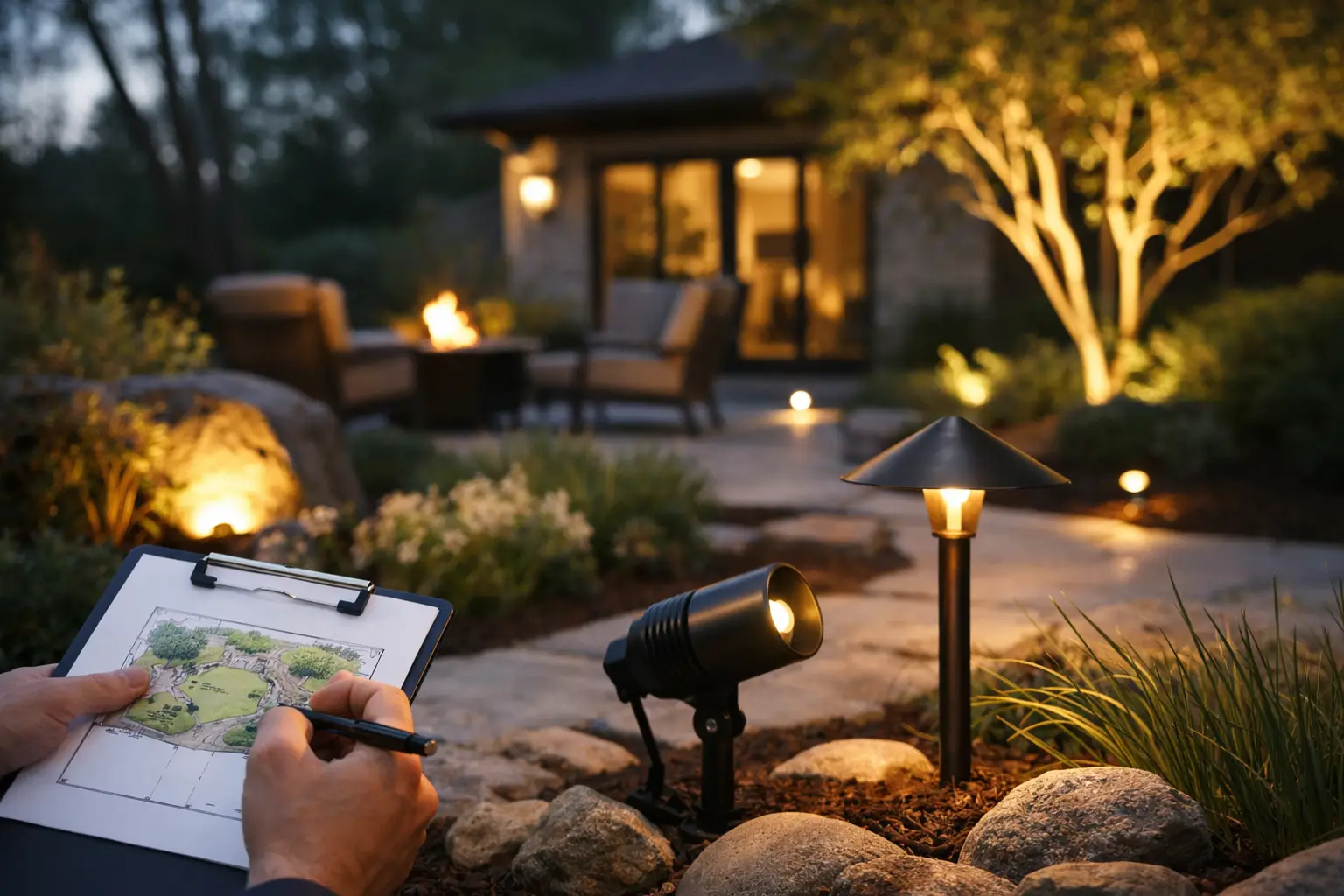
A beautiful landscape can disappear after sunset if the lighting plan is treated as an afterthought. The strongest outdoor environments carry their design intent into the evening, which is why knowing how to design landscape lighting matters well beyond fixture selection. Done properly, it improves safety, reveals architecture, supports circulation, and gives the site a composed, finished character at night.
For high-value residential properties, lighting should not read as decoration added at the end. It should be integrated into the broader site design, with careful attention to views, grading, planting maturity, hardscape materials, and how the property is actually used after dark. That is where the difference lies between a yard that is simply illuminated and a landscape that is professionally lit.
How to design landscape lighting starts with purpose
The first step is not choosing fixtures or lamp color. It is deciding what the lighting needs to accomplish on that specific property. In most cases, the goals fall into four categories: safe movement, visual hierarchy, architectural emphasis, and usable outdoor living space.
A front walk, drive court, or set of grade transitions needs clear, comfortable visibility. A specimen tree, water feature, or textured wall may deserve emphasis because it anchors the composition. Outdoor dining and lounge areas need light that supports use without feeling harsh or exposed. When these priorities are established early, the design becomes selective rather than excessive.
This matters because more lighting does not create a better result. Overlighting flattens the landscape, creates glare, and often makes premium materials look less refined. A disciplined plan uses contrast intentionally. Some areas should recede so others can lead.
Read the site before placing a single fixture
Every property has its own nighttime logic. The grade changes, entry sequence, plant palette, architecture, and neighboring views all affect what the lighting should do. A narrow side yard needs a different approach than a broad rear garden. A modern home with clean planes calls for a different visual rhythm than a Mediterranean residence with layered texture.
Begin by evaluating the property from the key viewpoints. Look from the street toward the entry, from the front door back to the drive, from the great room toward the pool terrace, and from any upper-level balconies down into the landscape. These are the views that define the nighttime experience.
It is also important to think ahead. Young plant material may look modest now, but canopy spread and shrub density will change how light performs over time. A fixture that works perfectly at installation can become buried, blocked, or overly dramatic as the landscape matures. Good design anticipates growth instead of reacting to it later.
Layer light instead of flooding the site
The most successful landscape lighting schemes are layered. They do not rely on one fixture type or one brightness level across the entire property. They combine functional light, accent light, and ambient glow to create depth.
Functional lighting handles circulation. This includes entries, walkways, stairs, drive transitions, and any changes in elevation. Accent lighting draws attention to focal points such as trees, specimen palms, sculpture, columns, or architectural walls. Ambient lighting supports outdoor rooms by making patios, loggias, and poolside spaces feel comfortable and inhabited rather than stark.
The balance between these layers depends on the site. A property centered on evening entertaining may need more attention on terraces, kitchens, and seating zones. A property with a long formal approach may place more emphasis on sequence and arrival. The design should respond to the way the landscape is meant to perform.
Use focal points with restraint
One of the most common mistakes in residential lighting is trying to feature everything. If every palm, hedge, and façade plane is illuminated, nothing stands out. Strong design establishes a hierarchy.
Choose the elements that carry the composition. That may be a mature live oak, an entry court, a sculptural stair, or the texture of a stone garden wall. Then support those elements with quieter secondary lighting. Background planting can remain subdued if the main structure of the landscape is clearly legible.
Restraint is especially important on luxury properties, where the expectation is polish rather than spectacle. The lighting should feel intentional and edited. If a guest notices the fixtures before they notice the space, the design likely needs refinement.
Fixture placement matters more than fixture count
When clients ask how to design landscape lighting, they often expect the answer to center on products. In practice, placement is the real discipline. The same fixture can create a refined effect or a distracting one depending on where it sits, what it aims at, and what surfaces surround it.
Path lights should guide movement without creating a runway effect. They work best when spaced for rhythm and visibility, not strict symmetry. Uplights at trees should consider trunk form, canopy density, and the viewing angle from primary gathering spaces. Wall washing can reveal beautiful texture, but if the beam is too strong or too close, it produces hot spots instead of a clean, even read.
Concealment is equally important. Fixtures should disappear into planting beds, architectural recesses, or hardscape edges whenever possible. A refined nighttime scene depends on seeing light effects, not hardware scattered across the site.
Consider beam spread, color temperature, and glare
These technical details shape the final result more than many property owners expect. Beam spread determines whether the light is tightly focused or broadly distributed. Color temperature affects whether materials appear warm and inviting or cool and clinical. Glare control determines comfort.
For most high-end residential landscapes, warmer color temperatures tend to complement natural stone, wood tones, and planting. Cooler light can make a property feel harder and less welcoming unless the architecture specifically calls for it. Beam spread should match the feature being lit rather than forcing a generic result on different elements.
Glare is non-negotiable. Poorly shielded fixtures near eye level, entries, seating areas, or water features can make a landscape feel uncomfortable even if the illumination levels are technically adequate. Good lighting should support vision, not compete with it.
Integrate lighting with architecture, planting, and hardscape
Landscape lighting should never be designed in isolation. It needs to coordinate with paving patterns, retaining walls, steps, pool edges, planting beds, and architectural lines. A well-designed property has a visual language, and the lighting should reinforce it.
For example, a formal axis may benefit from measured, quiet emphasis that preserves symmetry and procession. A more naturalistic garden may call for softer, less predictable placement that reveals form without feeling rigid. Hardscape materials also influence the approach. Light behaves differently on shell stone, concrete pavers, turf block driveways, and dark masonry.
This is one reason lighting design is stronger when addressed during site planning rather than at the very end of construction. Conduit routes, sleeve locations, fixture recesses, and coordination with irrigation all become easier when they are planned from the beginning.
Design for maintenance and long-term performance
A lighting plan is only successful if it continues to perform after installation. Coastal and subtropical environments add pressure through moisture, salt exposure, heat, and aggressive plant growth. Materials, fixture durability, and access for adjustment all matter.
Fixtures need to be serviceable. Lamps or integrated components should be accessible without damaging adjacent planting or hardscape. Zones should be organized logically so the system can be adjusted as trees grow and outdoor living patterns change. Even an excellent initial design benefits from periodic aiming and review.
This is where professional oversight adds real value. The design intent can easily be diluted during installation if fixture locations shift in the field, beam angles are not tested at night, or the contractor treats the plan as approximate. Nighttime focus and final adjustment are part of the design process, not an optional extra.
Know when simplicity is the right answer
Not every area needs a dramatic effect. Some of the best lighting decisions are the ones that preserve darkness. Peripheral planting, side setbacks, and distant boundaries often benefit from a lighter touch, especially if the primary goal is to frame the main architecture and outdoor living spaces.
Simplicity also helps control future clutter. If the initial plan is disciplined, additions can be made thoughtfully over time. If the first installation is overbuilt, correction usually means removing or relocating fixtures rather than improving the design.
For clients investing significantly in their property, that distinction matters. Good lighting should age well, adapt well, and continue to support the broader landscape composition as the site matures.
A well-resolved lighting plan does not call attention to itself. It makes the property feel complete after dark, with the same level of care, proportion, and technical precision that defines the landscape in daylight. If the nighttime experience feels calm, legible, and quietly impressive, the design is doing its job.