
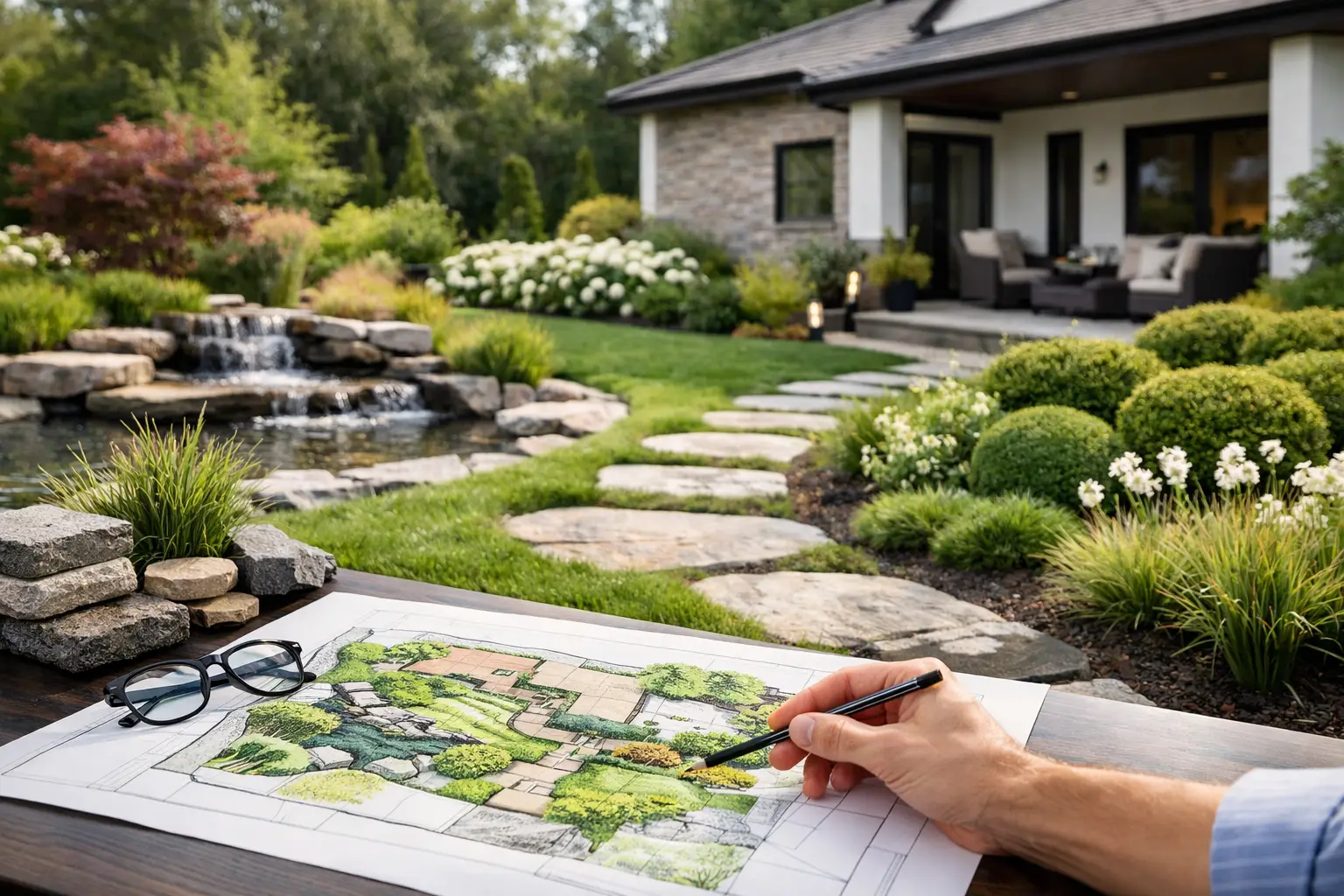
Most landscape problems start before a single plant goes in the ground. A beautiful front approach, a calm pool terrace, or a private garden court can all fail if the grading is wrong, drainage is ignored, or the layout never truly fit the architecture in the first place. That is why knowing how to design landscape around house means thinking beyond decoration. The strongest landscapes are planned as part of the property, not added to it.
For high-value residential projects, the goal is not simply to fill beds and edge a lawn. It is to create an outdoor environment that feels intentional from the street to the rear property line, works in daily life, and holds up over time. That requires design judgment, technical discipline, and a clear understanding of how people will move through the site.
How to design landscape around house starts with the site
Before discussing plant palettes or paving materials, start with what the property is already telling you. The house sets the architectural language, but the site determines what is possible. Grade changes, drainage patterns, sun exposure, privacy issues, existing trees, utility locations, and setbacks all shape the design.
A flat lot offers flexibility, but it can also create drainage challenges if water has nowhere to go. A narrow side yard may look secondary on paper, yet it often becomes a critical circulation route for service access, guest movement, or visual buffering from a neighboring property. On waterfront or coastal properties, wind and salt exposure change material and planting decisions in a very practical way.
This early analysis is where many homeowners underestimate the value of a professional landscape architect. If the outdoor plan does not respond to drainage, grading, and use patterns from the beginning, even expensive finishes can feel disconnected or perform poorly.
Start with function, not finishing touches
The most successful residential landscapes are organized around use. Ask what the property needs to do before deciding how it should look. A primary residence may need guest arrival space, screened service areas, pet circulation, pool access, outdoor dining, and privacy from adjacent lots. A seasonal home might prioritize low-maintenance planting, irrigation efficiency, and durable hardscape over large lawn areas.
These are not minor decisions. They determine the layout. If the entertaining terrace is too far from the kitchen, it will be used less. If the driveway approach is oversized and visually dominant, it can diminish the architecture. If seating areas are placed without considering western sun exposure, they may become uncomfortable for much of the year.
Good design establishes zones with purpose. Public areas near the street and entry should support a strong first impression. Transitional spaces should guide movement naturally. Private outdoor rooms should feel sheltered, scaled correctly, and connected to the interior of the home.
Think in outdoor rooms
One useful way to organize the design is to think of the landscape as a sequence of rooms rather than a leftover perimeter around the building. The arrival court, front walk, side garden, pool terrace, lawn panel, and rear garden can each serve a different purpose while still feeling cohesive.
This approach gives the site structure. It also helps avoid the common problem of treating every edge of the house the same way. The front foundation landscape should not necessarily match the rear entertaining space, and the side yard should not be designed as if it were just a narrow planting strip. Each area should respond to visibility, function, and scale.
Match the landscape to the architecture
A well-designed landscape should reinforce the character of the home, not compete with it. Clean-lined contemporary architecture often benefits from controlled massing, restrained plant selection, and strong geometric hardscape layout. A more traditional residence may support layered planting, axial views, and a formal entry sequence.
This does not mean the design must be rigidly symmetrical or historically literal. It means the proportions, material choices, and planting composition should feel aligned with the house. A refined home deserves more than a generic package of shrubs, sod, and accent palms placed at even intervals.
Scale matters here. Large homes need landscape elements with enough mass to hold their own visually. Small ornamental plants placed against a substantial facade often look temporary or undersized. At the same time, oversized planting too close to the structure can overwhelm windows, block views, and create maintenance issues within a few years.
Hardscape should lead the design
When people think about landscaping, they usually think first about plants. In reality, hardscape often carries the design. Driveways, walks, terraces, walls, steps, and pool decks establish the geometry, circulation, and usability of the site.
If these elements are poorly located or weakly detailed, the landscape will never feel resolved. A good hardscape plan considers approach, proportion, drainage, finish materials, and how each surface meets the next. That includes transitions from driveway to entry, terrace to lawn, and house to pool.
Material selection should be driven by both aesthetics and performance. Natural stone, pavers, shellstone, concrete, and specialty finishes each have a place, but they age differently, handle moisture differently, and create different visual temperatures. On high-end properties, refinement usually comes from disciplined material use and detailing, not from using more materials than necessary.
Drainage is part of design, not a separate issue
Drainage should never be treated as an afterthought. Around a house, poor drainage can affect foundations, damage hardscape, stress planting, and create persistent maintenance problems. A landscape plan must direct water intentionally through grading, swales, collection systems, and finished elevations that work together.
This is especially important in Florida conditions, where heavy rains can test every weak point in a site plan. The visual side of the design and the engineering side have to support one another. A landscape that looks elegant on paper but holds water at the base of the house is simply incomplete.
Planting should shape space, not just add color
Planting design is most effective when it defines edges, controls views, softens architecture, and brings seasonal interest without creating clutter. The question is not how many species to include. The question is what each planting area needs to accomplish.
At the front of the house, planting may frame the entry and support the architecture. Along property lines, it may create privacy or screening. Near outdoor living areas, it may provide softness and enclosure without shedding excessively into pools or paved areas. In focal zones, specimen trees or sculptural planting can create memorable moments.
A restrained palette often looks more sophisticated than a collection of unrelated plants. Repetition creates cohesion. Layering creates depth. Mature size should always guide spacing. Landscapes that are installed too tightly may look full on day one but become expensive to manage and visually crowded over time.
Lighting and irrigation deserve equal attention
A landscape is experienced after sunset as much as during the day, especially in outdoor living environments. Lighting should support safety, architecture, and atmosphere. That means illuminating walks and transitions clearly while using restraint around planting and focal elements. Overlighting can flatten the site and make even a well-designed property feel harsh.
Irrigation should also be planned with precision, not treated as a standard add-on. Turf, foundation planting, specimen trees, and container areas often have different water needs. Zoning, coverage, and head placement affect plant health, water use, and long-term maintenance costs. A design that looks excellent at installation but cannot be irrigated properly will not perform as intended.
How to design landscape around house for long-term value
The best answer to how to design landscape around house is not the fastest answer. It is the one that anticipates how the property will mature. Trees will grow, views may change, drainage patterns will be tested, and family needs may shift over time.
That is why long-term value comes from planning documents that are buildable and coordinated. Concept sketches are useful, but serious residential projects often require grading and drainage plans, planting plans, irrigation design, hardscape detailing, and construction documentation that contractors can execute accurately. Design intent is only protected when it is clearly documented and reviewed through implementation.
For homeowners and project teams making significant investments, this level of planning reduces guesswork. It also protects the finished result from field decisions that dilute the design.
A landscape around a house should do more than improve curb appeal. It should solve problems quietly, support the architecture, and make the property feel complete. If the layout is thoughtful, the grading works, and every material and planting choice has a reason for being there, the result will not just look finished. It will feel settled, functional, and built to last.