
A beautiful property can be undermined by one persistent problem – water that has nowhere to go. Effective landscape yard drainage is not a cosmetic upgrade. It protects foundations, preserves hardscape, keeps planting beds healthy, and prevents a finished landscape from looking tired long before it should.
On high-value residential properties, drainage problems usually show up in predictable ways. Water pools near entries or lanais. Turf stays saturated in isolated areas. Mulch migrates after every storm. Pavers settle. Bed edges erode. In more serious cases, runoff moves toward the house instead of away from it. Each symptom points to a grading or collection issue, not just a surface nuisance.
Why landscape yard drainage should be planned early
Drainage works best when it is integrated into the site plan from the beginning. Once a property has finished paving, mature planting, lighting, and irrigation in place, correcting elevations becomes more disruptive and more expensive. That is especially true on custom homes where exterior spaces are layered with terraces, retaining edges, driveways, pool decks, and detailed planting design.
A well-developed drainage strategy starts with the site itself. Existing grade, finished floor elevation, soil behavior, roof runoff, hardscape layout, and municipal requirements all affect how water can be managed. In Florida, intense rainfall can overwhelm a yard quickly, so small elevation mistakes often become visible failures.
This is where design discipline matters. Good drainage planning is rarely about adding one drain and hoping for the best. It is about understanding how the whole property sheds water, where it concentrates, and how that movement can be redirected without compromising the design.
What causes drainage failure in a landscaped yard
Most drainage issues come from a combination of factors rather than one isolated defect. A flat lot may not have enough fall to move water naturally. A new patio or pool deck may interrupt the original drainage path. Downspouts may discharge too close to the structure. Even a beautifully installed planting bed can trap runoff if its edge sits higher than the surrounding grade.
Compaction is another common culprit. Construction traffic compresses soil, reducing infiltration and leaving water at the surface longer than intended. In some cases, irrigation compounds the problem. If spray coverage overlaps hardscape or low areas receive too much water, the yard stays wet even between storms.
Poor coordination between trades also creates avoidable problems. Hardscape installers, pool contractors, irrigation teams, and landscape crews may all perform quality work individually, yet the final site still fails if elevations and drainage intent were never coordinated in a single plan.
Signs your drainage problem is more serious than it looks
Some properties show obvious distress, while others fail more quietly. Standing water that lingers for more than a day after rain deserves attention. So do recurring algae or mildew on paving, exposed roots from erosion, and cracks or displacement in walks and driveways.
Plant material can also tell the story. If one section of lawn constantly declines, if palms or shrubs in a low bed show stress despite proper irrigation, or if root rot appears in otherwise suitable plant selections, excess water may be the real issue. On luxury properties, these failures often get misread as maintenance problems when they are actually drainage design problems.
Landscape yard drainage solutions depend on the site
There is no single best drainage system for every property. The right solution depends on slope, soil, available outfall locations, architecture, hardscape density, and how visible the drainage elements can be.
Surface grading is usually the first tool. If water can be directed away from structures and toward a suitable collection area through subtle reshaping, that approach is often the cleanest and most durable. The grading must be precise enough to move water without creating awkward transitions in lawn or hardscape.
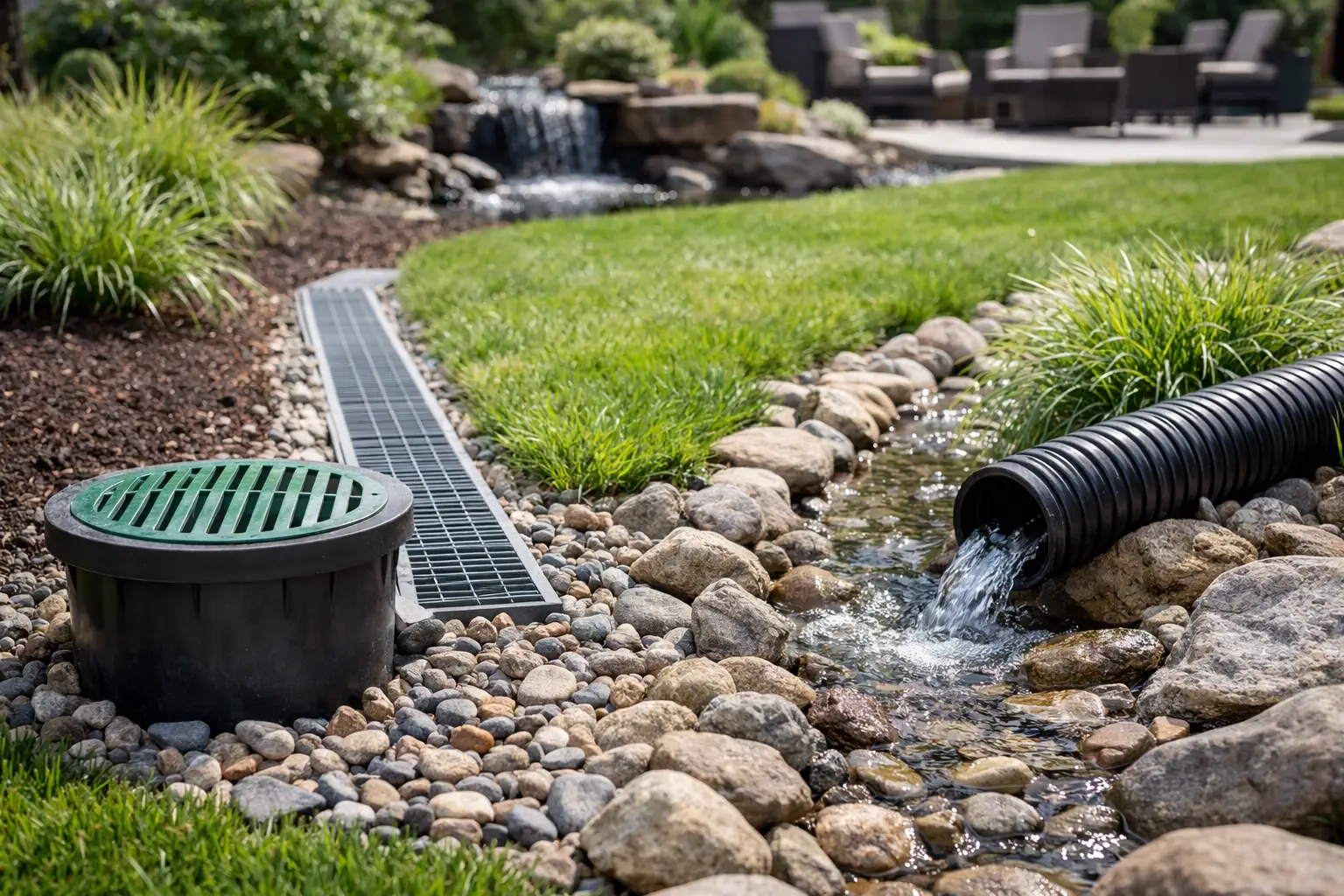
Area drains and catch basins are useful when runoff concentrates on paved surfaces, courtyards, or low lawn pockets. These systems collect surface water and route it through underground piping. Their success depends less on the drain cover itself and more on proper placement, pipe sizing, slope, and discharge location.
French drains can help in specific conditions, particularly where subsurface water needs to be intercepted. They are frequently misunderstood and overprescribed. A French drain is not a cure-all for standing water caused by poor surface grading. If the visible problem starts at the surface, grading and collection usually need to be addressed first.
Downspout management is another critical piece. Roof water sheds quickly during heavy rain, and if that volume is released near the house or into planting beds without a controlled route, erosion and saturation follow. Extending roof runoff into a coordinated drainage network is often necessary on larger homes.
In some cases, dry wells, swales, or engineered retention approaches may be appropriate, but these require careful evaluation. What works on one property may be ineffective or even noncompliant on another.
The design balance between performance and appearance
Well-executed drainage should not dominate the visual experience of a landscape. On a refined residential project, drainage elements need to perform reliably while remaining visually quiet. That means grates should align with paving geometry, swales should feel intentional rather than accidental, and collection points should be integrated into the broader site composition.
This is where design and technical planning must work together. A drainage fix that solves ponding but interrupts circulation, weakens planting composition, or creates obvious utility scars is only a partial success. The goal is to protect the property without sacrificing elegance.
A design-forward approach also considers how drainage affects material selection. Certain paver patterns, joint treatments, edging details, and turf transitions are more forgiving in wet conditions than others. Likewise, plant selection should respond to actual moisture patterns on the site, not just aesthetic preference.
Why drainage details matter during construction
Even excellent plans can fail if they are not verified in the field. Finished elevations shift. Subgrades vary. Contractors may adjust installations to accommodate site conditions. Without oversight, those minor changes can alter water flow enough to create a problem.
Field review is essential for this reason. Drain inlets need to be set at the right elevation. Hardscape must pitch correctly. Pipe runs require consistent slope. Planting beds should not be built up in ways that trap runoff against structures or paving. These are not dramatic decisions, but they determine whether the system works after the first major storm.
Experienced landscape architects pay close attention to this stage because drainage is unforgiving. Water reveals inaccuracies quickly. A property may look complete at turnover, then show failure once summer rains arrive.
Drainage planning for luxury homes and complex sites
The larger and more detailed the property, the more layered the drainage strategy needs to be. Residences with pools, guest houses, detached garages, expansive driveways, and multiple outdoor living areas often require several collection and conveyance methods working together.
On these projects, drainage planning also affects permitting, construction sequencing, and consultant coordination. Architects, civil engineers, builders, and landscape architects each influence how the site ultimately performs. The strongest outcomes come from a unified plan rather than disconnected decisions made by discipline.
For homeowners and builders, that coordination reduces costly revisions later. It also helps preserve the design intent. At firms such as Nova LA Designs, grading and drainage planning is treated as part of the overall design framework, not an afterthought once the visual elements are complete.
When to address drainage before it becomes expensive
If a property is still in design, drainage should be resolved before finalizing hardscape and planting plans. If the home is already built, the right time is when symptoms first appear, before water begins damaging adjacent materials or forcing repeated maintenance.
Quick fixes have their place, but they rarely solve systemic drainage issues on high-investment properties. Adding topsoil to a low area, changing irrigation settings, or replacing stressed plants may improve appearances temporarily. If grades and runoff patterns remain unchanged, the problem usually returns.
A professional evaluation brings clarity. It identifies whether the issue is primarily surface runoff, subsurface saturation, roof discharge, hardscape pitch, or a combination of these. That distinction matters because the wrong solution often adds cost without improving performance.
A landscape should feel composed and effortless, even when it is managing large volumes of water behind the scenes. When drainage is planned with the same care as paving, planting, and architecture, the result is not only a better-looking property, but one that holds its value and performs the way it was intended to.