
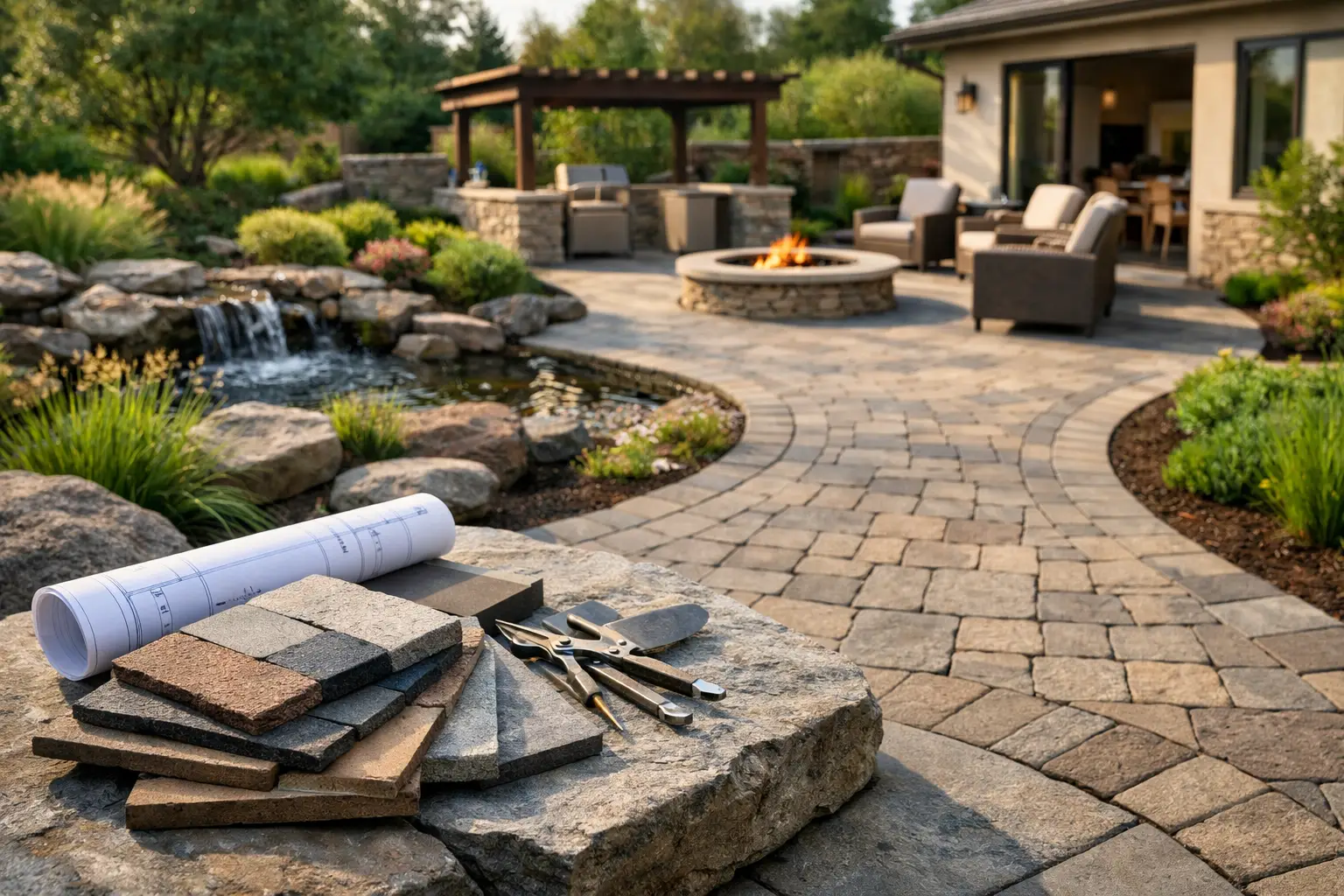
A great outdoor space usually fails or succeeds long before the first paver is installed. The layout, grading, drainage, material selection, and construction detailing all determine whether a patio feels effortless for years or starts showing movement, water issues, and awkward circulation within a season. That is why a residential hardscape design guide should start with planning, not products.
For high-value homes, hardscape is not filler between the house and the planting. It is the structural framework of the landscape. It shapes how you arrive, where you gather, how water moves, how the pool terrace performs, and how the architecture connects to the site. When handled well, it adds daily function and measurable property value. When handled poorly, even expensive materials can look unresolved.
What a residential hardscape design guide should cover
Most homeowners think first about visible features such as a driveway, pool deck, walkways, retaining walls, fire features, or an outdoor kitchen. Those elements matter, but they are only part of the design problem. A strong hardscape plan also addresses circulation, finish transitions, edge conditions, drainage strategy, elevation relationships, lighting integration, and the way each space relates to the architecture.
This is especially true on custom residential properties, where the hardscape often has to do several jobs at once. A front court may need to establish a strong arrival sequence, support guest parking, handle runoff, and still feel proportional to the home. A rear terrace may need to accommodate dining, lounging, sun exposure, and access to the pool while keeping door thresholds, drainage slopes, and material temperatures in check.
The design process works best when these issues are addressed together rather than in isolated decisions. Choosing pavers before confirming grading, for example, often leads to avoidable revisions. The same is true when drainage is treated as a fix rather than a design driver.
Start with how the property needs to function
The first question is not what material you like. It is how the site should work. Every residence has a hierarchy of outdoor use, and hardscape should reinforce it. Some properties need formal arrival and clear front-door definition. Others need large-scale entertaining zones, service access, privacy buffers, or stronger pool integration.
The site itself will also set limits. Existing grades, mature trees, utility locations, drainage patterns, setbacks, and architectural geometry all shape what is possible. In Florida, seasonal rain, intense sun, salt exposure in coastal areas, and heat gain on walking surfaces should influence early decisions. A beautiful plan that ignores those conditions rarely performs as intended.
This is where professional site planning adds value. It tests space allocation before construction documents are developed and helps avoid a common problem on luxury homes: generous square footage with no real logic to how people move through it. Well-designed hardscape feels composed because it has been organized around actual use, not just visual symmetry.
Circulation is one of the first design tests
Walkways, drive aisles, entry courts, and terrace connections should feel intuitive. Guests should understand where to arrive and where to go next without visual clutter or forced detours. Service routes should be practical without competing with the primary experience of the property.
Width matters here more than many people expect. A narrow walk may look fine on plan but feel cramped in person. An oversized terrace can feel exposed if it is not broken into usable zones. The right proportions depend on the architecture, the scale of the lot, and the intended lifestyle.
Grade relationships matter as much as layout
Hardscape design is tied directly to elevation. Even subtle level changes affect comfort, safety, and drainage. Patios need enough slope to move water without feeling tilted. Steps should land naturally with door thresholds and adjacent paving. Retaining conditions should be integrated into the overall composition, not treated as leftover engineering.
On refined residential projects, these transitions should feel quiet and resolved. That usually requires careful dimensioning and technical coordination well before construction begins.
Material selection is about performance, not just appearance
Stone, concrete pavers, poured surfaces, shell aggregate, porcelain, and specialty finishes each have a place in residential work. The right choice depends on architecture, maintenance expectations, climate exposure, slip resistance, heat retention, and the desired character of the space.
Natural stone can bring depth and distinction, but it requires disciplined detailing and an understanding of how it weathers in the local environment. Concrete pavers offer flexibility and consistent sizing, though the pattern, border treatment, and installation quality make the difference between a tailored result and a generic one. Porcelain can perform very well in contemporary settings, but substrate preparation and drainage details are critical.
A common mistake is selecting too many finishes. High-end hardscape usually benefits from restraint. A limited, well-coordinated palette tends to feel more architectural and gives planting, furnishings, and water features room to contribute. Contrast still matters, but it should be deliberate. A driveway, front walk, and pool deck do not all need the same surface, yet they should belong to the same composition.
Drainage should shape the design from the beginning
If there is one issue that separates polished hardscape from costly hardscape, it is drainage. Water management is not an add-on. It affects elevations, paving patterns, deck edges, retaining structures, slot drains, swales, and the long-term stability of the finished work.
On residential properties, drainage problems usually show up in familiar ways: standing water on patios, runoff toward the home, erosion at bed edges, staining on paving, and settlement in poorly prepared areas. These are not simply construction defects. They often begin with incomplete planning.
A sound approach studies where water comes from, where it needs to go, and how the hardscape can support that movement without visual disruption. In many projects, the best drainage solutions are the least noticeable because they were integrated into the design early. This requires technical judgment, especially when pool decks, lawn areas, driveways, and structures all interact.
The best hardscape feels tied to the architecture
Hardscape should extend the home, not compete with it. That connection comes from more than matching colors. It depends on line, proportion, geometry, and finish quality. A Mediterranean residence, a coastal transitional home, and a contemporary estate each call for different detailing disciplines.
For traditional architecture, the paving pattern, edge definition, and stair composition often carry the character. For more modern homes, alignment, spacing, and clean transitions tend to matter more than ornamental variation. In both cases, the outdoor space should feel like it belongs to the house and the site at the same time.
This is one reason custom detailing matters. Border conditions, coping profiles, riser treatments, expansion joints, and material transitions are small decisions on paper but major contributors to the finished result. They are also where design intent is most likely to get diluted if documentation is vague.
Construction documents are not just for contractors
On complex residential projects, clear documentation protects the owner as much as the builder. It translates design intent into dimensions, elevations, material notes, layout logic, and coordination requirements that can actually be built. Without that level of detail, pricing becomes less reliable and field interpretation becomes more subjective.
For homeowners investing in custom outdoor environments, this is where professional oversight has practical value. Hardscape is expensive to revise once installed. The more precise the drawings and specifications, the better the chance that the finished work reflects the original design rather than a series of on-site assumptions.
This is also where collaboration becomes essential. Landscape architects, builders, pool designers, civil engineers, and irrigation professionals all affect the same ground plane. If those disciplines are not aligned, the result is usually compromised in ways that are difficult to hide later.
Where homeowners should be careful
Budget discussions often push hardscape decisions toward simplification, and sometimes that is appropriate. Not every site needs elaborate paving or extensive built elements. But reducing square footage is different from reducing planning. A simpler design can still be highly disciplined.
The larger risk is spending heavily on visible features while underinvesting in the unseen work that supports them. Base preparation, drainage coordination, grading precision, and layout control rarely make the photo set, but they determine longevity. The same is true of choosing materials that look refined in a sample but perform poorly in full sun, frequent rain, or near a pool.
Another caution is trend-driven design. Outdoor spaces age better when they are grounded in the home’s architecture and the owner’s actual use patterns. A feature that photographs well today may feel dated or impractical surprisingly fast. Timelessness usually comes from proportion, restraint, and technical discipline rather than novelty.
A practical way to evaluate your plan
If you are reviewing a hardscape concept, ask a few direct questions. Does the layout make movement easy and natural? Are elevations and drainage resolved, not assumed? Do the materials fit the architecture and climate? Has the design accounted for service areas, lighting, irrigation coordination, and construction detailing? And perhaps most important, will the finished space still feel intentional after furnishings, planting, and daily use are added?
A good plan answers those questions on paper before they become field problems. Firms such as Nova LA Designs build value by pairing design judgment with technical documentation and project oversight, which is often what separates a visually attractive concept from a finished landscape that truly performs.
The most successful residential hardscape is rarely the loudest. It is the one that fits the home, manages the site intelligently, and feels resolved every time you walk through it.