
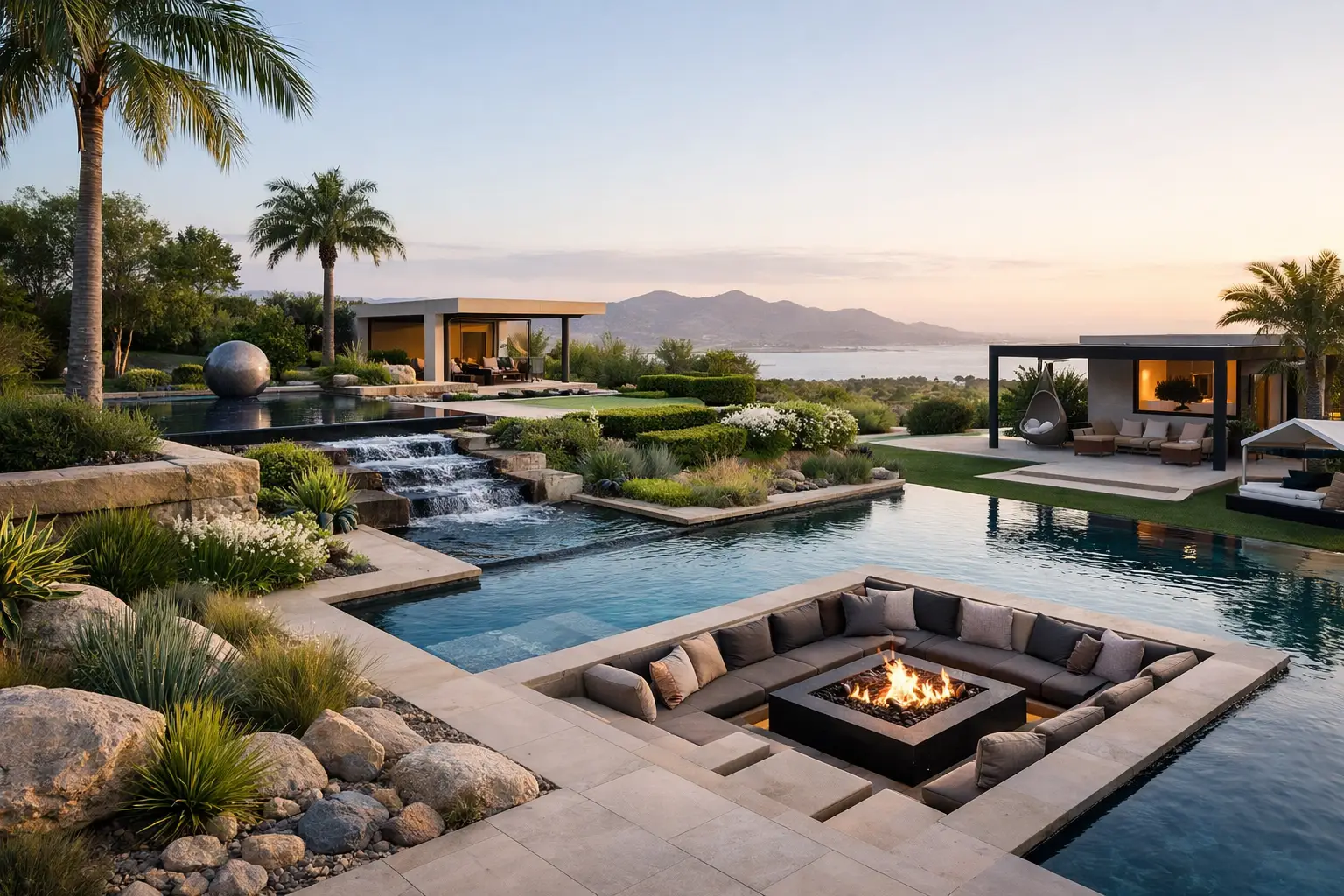
A well-funded landscape can still fail if it is treated as decoration after the house is finished. The most relevant luxury landscape design trends are moving in the opposite direction – toward landscapes planned with the same rigor as architecture, engineering, and interior design. For high-end residential properties, that shift matters. It affects how a site drains, how outdoor rooms function, how materials age, and how the property ultimately feels to live in.
In the luxury market, trend should never mean novelty for its own sake. The strongest work is current without becoming dated, and expressive without ignoring construction realities. What is changing now is not simply plant selection or furniture style. It is the level of integration expected from the landscape itself.
Luxury landscape design trends are becoming more architectural
One of the clearest shifts is away from loosely arranged planting around a home and toward a fully composed site plan. Pools, terraces, drives, grading, lighting, shade structures, drainage, and planting are being considered as one design problem rather than separate scopes. That approach creates cleaner lines, better circulation, and fewer costly compromises during construction.
For custom homes, this often means the landscape architect is involved earlier. Site geometry is aligning more closely with the architecture. Axes are stronger. Entry sequences are more deliberate. Outdoor spaces are being organized as extensions of interior floor plans, not leftover areas around the building envelope.
The visual result is more refined, but the real value is technical. When paving elevations, drainage paths, retaining conditions, and planting zones are coordinated from the start, the project performs better over time. That is especially relevant on complex residential sites where aesthetics and infrastructure need to coexist without visible friction.
Outdoor rooms are replacing simple patios
Luxury clients are asking more from exterior space than a single terrace and a grill station. Outdoor environments are being planned as a series of rooms with distinct purposes – dining, lounging, quiet retreat, fire feature gathering, wellness, and guest entertainment. The difference is intentionality.
A successful outdoor room is not defined only by furniture. It is shaped by grade changes, low walls, ceiling elements, paving transitions, planting mass, and lighting. Privacy also plays a larger role than it once did. In tighter neighborhoods or exposed waterfront settings, screening has to feel elegant rather than defensive.
This trend also reflects how people actually use their homes. Owners want flexibility, but not at the cost of clarity. A landscape that offers several well-proportioned destinations typically feels more luxurious than one oversized open area trying to do everything.
The new luxury is restraint in planting design
There is still strong interest in tropical character, lushness, and seasonal color, particularly in Florida. But at the high end, planting design is becoming more edited. Clients are favoring compositions with stronger massing, fewer species, and a cleaner relationship between plant material and architecture.
That does not mean sparse landscapes. It means disciplined ones. Repetition, sculptural form, and controlled contrast are replacing the older habit of filling every bed with variety. The result is more cohesive and often easier to maintain at a high standard.
Another factor is long-term performance. Mature size, root behavior, salt tolerance, wind exposure, and irrigation demand are carrying more weight in design decisions. On premium properties, a plant palette must look composed on installation day, but it also has to hold its structure as the landscape matures. Beauty that collapses after two seasons is not luxury.
Native and climate-adapted plants are gaining ground
This trend is no longer driven only by sustainability messaging. It is being driven by performance and by the growing expectation that high-end landscapes should be both beautiful and intelligent. Native and climate-adapted species can reduce unnecessary water use, improve resilience, and respond better to local conditions, but selection still needs to be design-led.
The trade-off is that not every environmentally sensible plant delivers the visual character a luxury property needs. The best solutions usually blend regional appropriateness with strong form, texture, and structure. Done well, the landscape feels tailored to place rather than generic.
Hardscape materials are getting quieter and more exact
Material selection in luxury landscapes is trending toward restraint. Oversized patterns, busy color variation, and decorative excess are giving way to cleaner stone palettes, larger-format pavers, refined concrete finishes, and carefully detailed joints. Precision is becoming part of the aesthetic.
This is partly visual and partly practical. Simpler material programs tend to age better and support the architecture rather than competing with it. They also demand tighter detailing. Once a project relies on proportion, alignment, and clean transitions, construction quality becomes far more visible.
Driveways are also receiving more design attention. Paver and turf driveway concepts, textured concrete, and custom banding patterns are being used not just for curb appeal, but to establish the design language from the street. On significant homes, the driveway is often the first signal of whether the landscape was truly designed or merely installed.
Lighting is becoming part of the architecture
Landscape lighting at the luxury level is moving beyond basic path illumination and accent uplighting. Clients increasingly want lighting that shapes mood, supports evening use, and reinforces the architecture without glare or visual clutter.
That requires discipline. More fixtures do not automatically create a better result. In fact, over-lighting is one of the quickest ways to cheapen an expensive property. The current direction favors layered, subtle lighting plans that address arrival, safety, focal features, specimen planting, and entertainment zones with a calibrated hand.
Integrated lighting in walls, steps, water features, and overhead structures is also more common. These systems need to be coordinated early, because they affect construction details, conduit planning, and fixture placement. Like many current trends, the real advantage comes from design coordination rather than product selection alone.
Water, wellness, and sensory experience
Pools remain central to many luxury residential landscapes, but the surrounding design is evolving. Clients are placing more emphasis on wellness features, quieter spatial experiences, and sensory quality. Sun shelves, cold plunge elements, spa courts, outdoor showers, and garden zones intended for private retreat are all becoming more common.
Water features themselves are also changing. There is less demand for ornamental excess and more interest in controlled, architectural expressions of water – reflecting surfaces, knife-edge details, subtle spillways, and features that contribute sound without dominating the space. The best of these are integrated into the site composition, not added as an accessory.
For some properties, especially where space is limited, the right move is restraint. A smaller but precisely designed water element can create more value than a larger feature that overwhelms circulation or planting opportunities.
Performance planning is now part of luxury landscape design trends
One of the most meaningful changes in luxury landscape design trends is invisible to most guests. High-end clients are paying more attention to what supports the finished appearance: drainage, grading, irrigation planning, construction documentation, and implementation oversight.
That shift is overdue. In many residential projects, the site fails long before the materials do. Water sits where it should move. Turf struggles because drainage and irrigation were never coordinated. Hardscape settles because grading transitions were resolved in the field instead of on paper. These are not minor technicalities. They shape whether a property functions like a premium environment or an expensive patchwork.
Sophisticated clients and project teams increasingly understand that design intent must survive construction. That is why detailed plans, coordination with architects and engineers, and hands-on review during implementation matter so much. A landscape should not rely on improvisation once excavation begins.
Privacy without heaviness
Privacy remains a top priority in luxury residential work, but the preferred expression is changing. Tall perimeter hedges alone are no longer enough, and in some cases they create a blunt, overbuilt feel. More nuanced privacy design uses layered planting, grade manipulation, screen walls, specimen trees, trellis structures, and strategic orientation of gathering spaces.
This approach feels more architectural and more livable. It can also improve airflow, light access, and visual depth. The right solution depends on site conditions, adjacency, and how the owner intends to use the space. Absolute screening may be appropriate in one rear yard and unnecessary in another where framed views are part of the property’s value.
Technology is supporting, not leading, the design
Homeowners at the top of the market are interested in control systems for irrigation, lighting, audio, and pool environments, but the best projects treat technology as support. It should make the landscape easier to manage, not turn it into a gadget display.
Smart irrigation is especially relevant because it can respond to weather and reduce waste, but it still depends on correct zoning, pressure considerations, and plant-appropriate coverage. Technology cannot compensate for a poor plan. The same is true for lighting controls and outdoor automation. The system is only as good as the design it serves.
For firms like Nova LA Designs, this is where experience carries unusual weight. A polished rendering may win early enthusiasm, but a truly successful luxury landscape depends on technical decisions that protect the design long after installation.
The strongest landscapes being built now share a common trait. They are not chasing trends as visual shortcuts. They are using current ideas to create outdoor environments that are precise, durable, and deeply aligned with the home. That is the direction worth following, because a landscape should feel just as intentional ten years from now as it does on the day it is completed.